
A Woman of Distinction 1920-2014
A COLUMN By Kathryn Ross
One of the women I often overlook when I talk about forming Music on the Lawn in the late 1990s is Barbara Mather Chapin Williams. She was extraordinary and certainly a member of the community who should be recognized for her contributions during Women’s History Month.
I can’t be sure when I officially got to know Barbara. The proprietor of the Mather Homestead on North Main Street, the Yellow, boxy house was one of the first of the grand structures on North Main St. That was long before Helen Mather Chapin, Barbara’s mother, was born. She was Barbara’s connection to Wellsville. Barbara grew up and was educated in Cleveland, OH and often visited as a grandchild of Wellsville. She was born in 1920 and upon her graduation from a progressive girl’s school at 17, her father gifted her an 810/812 Cord automobile. It was one of the most modern vehicles of the time, as was Barbara. She attended Scripps Liberal Arts College for Women in California.
When the nation’s main highways meandered from small towns and small cities, past natural wonders like Pikes Peak, Barbara and her mother drove the Cord across country from California to Wellsville. They stopped at the Bonneville Salt Flats where Barbara steered the Cord to 120 miles per hour across the desert landscape.

Before moving to her home in Wellsville where her divorced mother lived, Barbara developed the concept of delivering culture and art to rural communities. She called it the Carnival Caravan and Artmobile which would travel from community to community. The concept was endorsed by Eleanor Roosevelt. The idea died from lack of support in the late 1950s and early 1960s
By 1966, Barbara was living in New York City, where she worked with the Quakers and protested against the Vietnam War. At a Quaker meeting at Christmas time she met her husband Glenn Williams a musician and composer. They were married in Shakespeare’s Gardens in New York City six months later.
Glenn and Barbara traveled the world and for a while the couple made their home in Hawaii, London, Dublin, La Havre, Switzerland, Chicago, Canada and New Orleans. They extensively traveled in Southeast Asia and Asia. After her husband’s death in 1987, Barbara returned to a lonely Mather Homestead in Wellsville. Her mother had also passed away. She began turning the family home into a museum for the blind and visually handicapped. Glenn had suffered from cataracts.
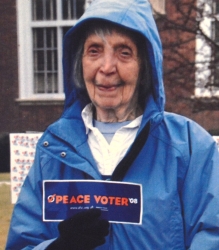
In 1989. Barbara, who had supported McGovern in 1968, supported the anti-nuclear waste dump protest. I found the 69-year-old on the protest lines and at the meetings until the end. A few years later I found her protesting President George Bush’s 2003 Iraqi War.
She would buttonhole me on the street whenever she saw me, to talk about local problems and national politics.
By 1998 I had started MOTL. That summer, I had scheduled a performance which required 30 to 40 chairs to be set up on the library lawn for the performers. The chairs were carried by MOTL volunteers from a small closet in the gallery in the library to the lawn and set up. At the end of the night when the chairs had to be returned to the closet, I noticed a white-haired woman helping to carrying the wooden chairs back into the library. It was Barbara Williams. She was in her early 70s.
That was when I truly got to know Barbara. After that, I visited her at the Mather Homestead. On July 4th each year, I sat on her porch with her other friends and read the Constitution of the United States out loud. I took photos of the kids knocking on her doors at Halloween and touring the museum, playing the instruments and looking at the treasures. I took photos of kids decorating the paving stones along the sidewalk that led to her porch and searching for decorated eggs at Easter time. I read her writings and cherished her simple line drawings. She was a member of the Thelma Rogers Genealogical and Historical Society, the Allegany Arts Association and other community groups.
But most of all, she was a concerned citizen who never hesitated to hold up a sign, write a letter, or voice, her opinion? And who promoted all forms of culture and art.
She was a true woman of distinction and someone well worth remembering this Women’s History Month as a daughter of Wellsville who made a difference.
Kathryn Ross is a Wellsville native, a longtime journalist and writer, and a community activist. You can reach her anytime, kathr_2002@yahoo.com