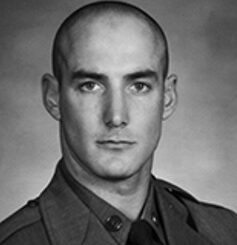

Charles M. Dutton graduated from Wellsville High in 1964, died in My Lai, Vietnam in 1968
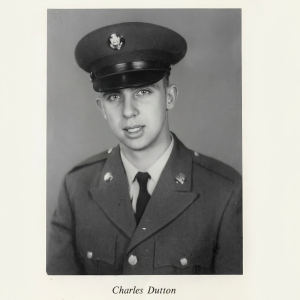
By Peg Ellis, pictured is SP5 Charles Dutton
*This contains graphic language describing the violence of war
This is the story of three young men, connected by a tragic twist of fate. Charles M. Dutton was a high school football player from the small town of Wellsville, NY. Glenn U. Andreotta of St Louis, MO dropped out of eleventh grade. Barry Lloyd was an airline pilot’s kid from Windsor Locks, CT.
The story is a little bit about me, too. I am a silver haired old lady who visited the Mobile Vietnam Memorial when it came to town over Independence Day Weekend in 2025. This was a big deal in my adopted town of Farmington, ME. A parade, distinguished speakers and ceremonial music by Native Americans were scheduled. My friend’s sewing group would distribute quilts to disabled veterans. Plus, there were free hotdogs downtown.
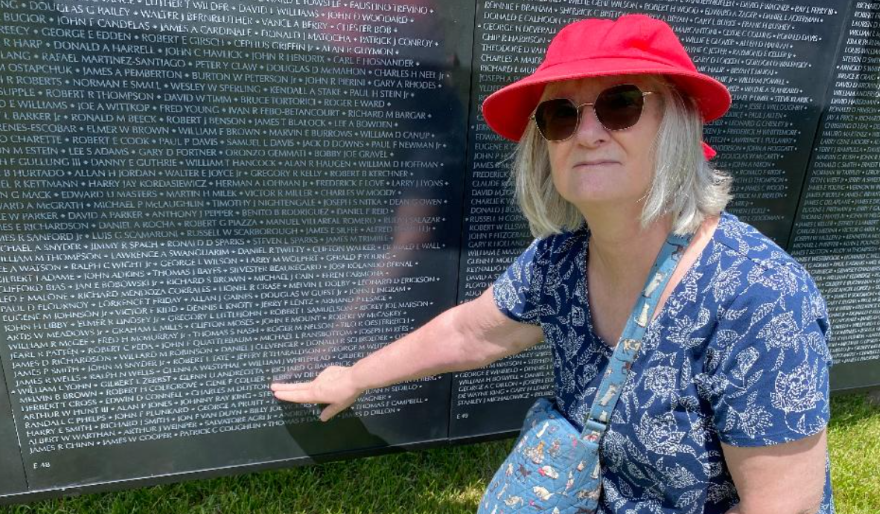
As I laid out my navy-blue dress and red hat to wear, I was struck by a thought. Wouldn’t this experience be more meaningful if I had a name to find on The Wall? The only fallen soldier I could think of was a cousin I’d never heard of until I read his obituary. Charles M. Dutton, 22, died in a helicopter crash in Vietnam on April 8, 1968.
I was eleven when Grandma showed me the laminated photo of a skinny soldier standing next to an American flag. I didn’t know what to say. First of all, why was I never informed about this cousin who lived in the same small town as me? Secondly, I felt so safe in Wellsville, I couldn’t fathom that any local boy could die in Vietnam, least of all a relative. The war came closer to home that day.
Why was my cousin a stranger? There are no relatives left to ask. It seems that Grandma kept in touch with Charles’ parents, but they were not close. I suppose the “ties that bind” grow slack after a couple of generations.

I was an idealistic child. The Vietnam War made no sense whatever to my young brain. There was a poster on my closet door that read: “War is Unhealthy for Children and Other Living Things.” We prayed for Vietnamese orphans at Catholic school. The nightly news baffled me. I knew we were trying to stop the spread of communism over there. But couldn’t we accomplish that without killing each other?
I remember exactly where I was the first time I heard Bob Dylan’s anthem “Blowin’ in the Wind.” It was in my friend Judy’s kitchen, and her older sister played the Peter, Paul, and Mary version for us. I thought, now that we have this song, there won’t be any more wars.” That line “how many deaths will it take ‘til we know that too many people have died” was easy for anyone to process. Kids and presidents.
Charles’ Army portrait remained on Grandma’s keepsake shelf until her death. I forgot his name until the same picture showed up on my genealogy page decades later. Charles M. Dutton. Born February 6, 1946. Died April 6, 1968, Quang Ngai region, Vietnam.
My cousin’s high school photo was endearing. He had the same ears and cockeyed smile as my dad (and me). With his slick Elvis pompadour, he looked like a cross between Wally Cleaver and The Fonz. Apparently, the “Mod Look” hadn’t reached Wellsville in 1963.
On the same genealogy page, I discovered another connection to Charles: our mutual ancestors moved to Wellsville from Starks, ME, about ten miles from where I live now.
Finally, I have a name to find on the Vietnam Wall!
So, I wrote the pertinent information on a sticky note and rode with my husband to the large field where the mobile replica was installed. As soon as we stepped onto the site, I felt my stomach tighten. The mood was somber. I was cold in my summer dress. There must have been a hundred visitors and volunteers in the field, but all I could hear over the wind was the soft drone of lowered voices.
Our first stop was the information booth where volunteers directed me to the exact location of Charles’ engraved name. Another volunteer showed me how to make a rubbing with a pencil and paper. Then, we walked over to other exhibits and read about world events in 1968. Martin Luther King and Robert F. Kennedy were assassinated that year. Support for the war was waning.
With my rubbing in hand, we returned to the car. I didn’t talk on the ride home. My mission was unfinished. I simply had to learn more about Cousin Charlie. He deserved more.
Once home, I googled the Vietnam Wall resources. Most cited facts I’d already learned from Charlie’s obituary. To glean wider context, I typed “Quang Nai 1968” into the search box.
Gasp! The search led to news articles concerning the My Lai Massacre. This incident has gone down as one of the most atrocious war crimes in American history. On March 16, 1968, US troops entered a village presumed to be a North Vietnamese strong hold. It wasn’t. But as many as five hundred unarmed women, children and elderly were executed, anyway.
No cousin of mine had better be involved in that atrocity! (Sigh of relief). Wrong company.
Next, I googled “Charles M. Dutton, SP5, Vietnam War.” His name appeared in articles about two other soldiers, Lloyd Barry and Glenn Andreotti. They turned out to be Charles’ crewmates on the helicopter when it crashed. Unlike Charles, both Andreotti and Lloyd received considerable press following their service.
On April 6, 1968, the three men were on a reconnaissance mission in Quang Nai province, a hotbed of Viet Cong activity at the time. Lt. Barry Lloyd was an experienced Army pilot. Glenn Andeotta, SP4, was the brave soul in the door gunner’s seat. My cousin was crew chief.
Their aircraft was a Hiller OH-23-G Scout, built for light cargo transport, not artillery. During its use in Vietnam, the doors were removed and unprotected gunmen fired through the opening. The M-60 weapon was secured by a bungee cord. Door gunners were said to have a six-minute life expectancy. This is an exaggeration, but it was one of the most dangerous duties in the war.
On that day, the crew responded to reports of Viet Cong activity near Quang Ngai. Along with two gunships, they were ordered to flush out and destroy the enemy. The helicopter was attacked by small arms groundfire. Andreotta was killed instantly by a single shot to the head. Essential controls of the helicopter were destroyed by anti-aircraft machine gun fire. Charles became covered in burning aviation fuel. When the helicopter made impact, he lay screaming on the ground until an enemy soldier shot him, as witnessed by Lloyd. The pilot was severely wounded and in shock. He pretended to be dead as he waited for rescue.
Decades later, I no longer believed war could be ended by a song. I understood the complexities of our involvement in Vietnam better. I wasn’t alone in wondering if our efforts were worth the cost. Now, the songs told the story from the veteran’s point of view, “Fortunate Son” by Credence Clearwater Revival and “Still in Saigon” by Charlie Daniels. We heard of the lasting effects of the war, Post Traumatic Stress Disorder, Agent Orange, suicides. They weren’t welcomed home with parades. They were called “Baby Killers.”
“Support the Troops” is a slogan I can grasp. We can do something about that.

Judy and I were about forty when we both returned to our hometown for a visit. It may have been the fourth of July because there was a parade on Main Street. We watched the fire trucks and scout troops go by in time with the marching bands. Decorated bicycles, civic groups on homemade floats, County Dairy Princess and high-stepping horses went by as we cheered from the curb. World War I and II veterans in their Sunday best smiled and waved from convertibles on loan from local car dealerships.
Then came the Vietnam Veterans. Compared to their older counterparts, this was a rag-tag group of fifty-year-olds, most with grizzled long hair and beards. Some were squeezed into their old uniforms like sausages. Others wore whatever part of the uniform they could still fit into. One veteran tried not to slump in his wheelchair while another pushed him along the route. Still, they stepped in time to a cadence, remembered, from years ago. This group did not smile and wave. The crowd was subdued. Judy whispered, “these men never got the respect they deserved.”
I made eye contact with one of the marchers. An overweight fellow, he wore oil-stained jeans and a faded work shirt. His jacket remained unbuttoned, and the sleeves were too tight to go over his shoulders. He had a swollen red nose, suggestive of excessive drinking. It looked like his feet hurt. He gazed at me sternly, as if to say “I ain’t here for your pity, Lady. I’m here for my brothers.”
Had he survived, Charles might have marched with these disheveled comrades in arms. My idealistic self likes to imagine that he came home, went to college, married a local girl, secured a good-paying job, and raised healthy sons who played football. We’ll never know “what if.”
I sometimes wonder what it would been like to have an older cousin in my life. Would he have played his records for me? I picture him having Elvis and The Beach Boys in his collection. What did he think of the Beatles’ appearance on The Ed Sullivan Show? Maybe he would have driven Judy and me to the roller rink.
Out of curiosity, I posted his name and picture on my hometown’s community website to see if anyone remembered him. Nearly one hundred comments appeared. High School classmates and neighbors posted epitaphs: “One of the Good Guys.” “Hometown Hero.” “Always a Warrior.”
It seems “Charlie” or” Chuck” got along well with people. He was the youngest in a blended family with seven children. His neighborhood, known as Proctor Terrace, was saturated with baby boomers. These were the days when kids played outside all day without adult interference. The so-called “Proctor Gang” played a lot of full-contact sports. Charlie was said to be a formidable opponent in pick-up football games. “He ran over me like I didn’t exist,” a poster commented.
Off the gridiron, Charlie was the kind of friend who’d help you with geometry during study hall. He would drop by a girl’s house and play cards with her mother. He skated at the nearby roller rink and pumped gas at the station down the road. I have the distinct impression my cousin was obsessed with cars, especially fast ones.
After high school, Charlie attended Alfred Agricultural and Technical College for a semester before shipping off to Germany, then Vietnam. He signed up for another six months in exchange for an earlier discharge date. A schoolmate observed his mother at the beauty parlor, crying over his decision.
On his last leave, Charlie visited his old high school where he interrupted a heated discussion between the vice-principal and a student. Charlie told the administrator he loved his job as a door gunner and would be returning for another tour. The student bystander posted “I remember that conversation like it was yesterday, and I thought about it many times in my life.” A few months later, he learned about the helicopter crash.
Also, while on leave, Charlie went bar hopping with his buddies and helped frost Christmas cookies at a girl’s house.
The 1969 Wellsville High School Yearbook was dedicated to Charles M. Dutton and Gary Coyle, also killed in Vietnam.
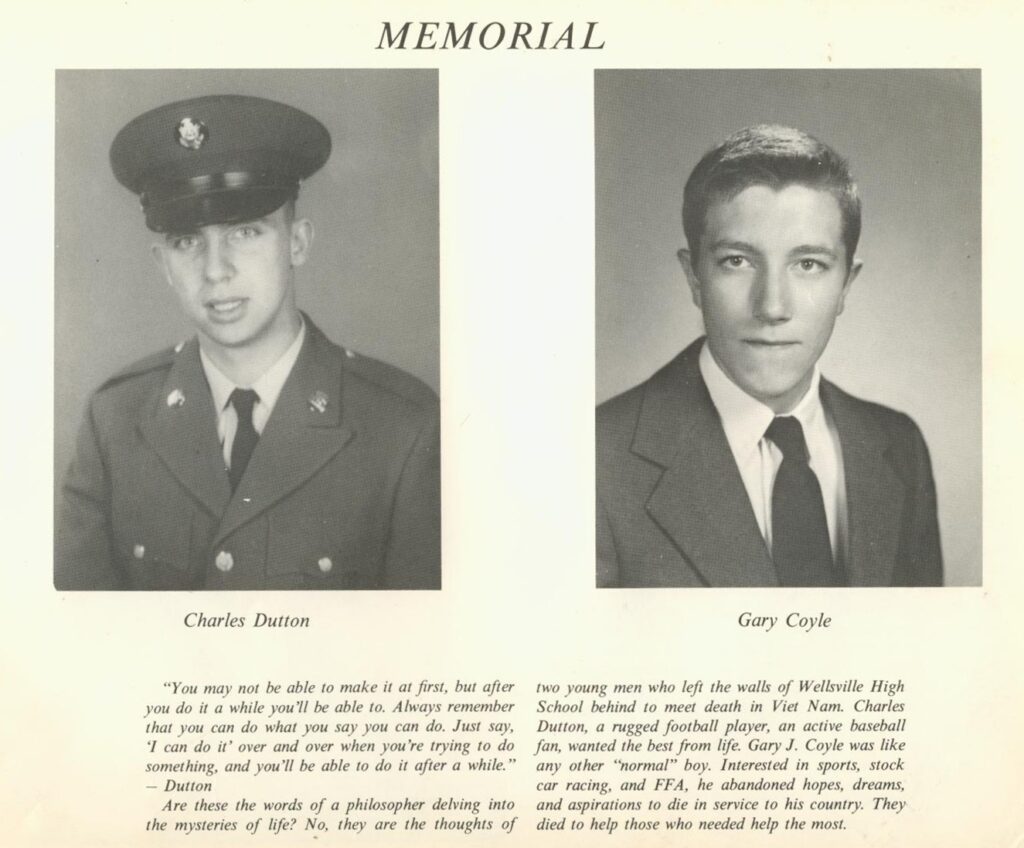
While I was able to learn something about Charlie’s teen years, information on Glenn Andreotta’s early life was scant. He was born October 30, 1947, in New Jersey, but grew up in St. Louis, MO. He dropped out of eleventh grade to enlist in the Army. The most significant event of his life occurred on March 16, 1968, in the village of My Lai, South Vietnam. Yes, My Lai, site of the infamous massacre.
To summarize, Second Lieutenant William L. Calley and his platoon were flown into My Lai that morning, expecting heavy resistance from the 48th Viet Cong Battalion. However, as they approached the hamlet, they were not met with gunfire. All they found were civilians going about their daily business. These were unarmed women, children, and elderly men. There was no “Plan B.” Lt. Calley led the men to execute the entire population. Orders were followed. As many as five hundred non-combatants were executed. There would have been many more deaths if it weren’t for the intervention of three men in a reconnaissance helicopter.
Earlier that morning, Glenn Andreotta, and his crew boarded their helicopter for “just another mission.” He would serve as crew chief with Warrant Officer Hugh Thompson as pilot and SP4 Lawrence Colburn as door-gunner. Their instructions were to scout the perimeter of My Lai to enable troops to make a safer landing in the presumed battle zone. Surprisingly, there was no gunfire as two platoons from Company C were flown in.
Andreotta’s crewmate Colburn recounted his experiences in the Seattle Times on March 10, 2002:
“It was Saturday, which was market day. We saw a lot of people leaving the village with empty containers and baskets, moving slowly, walking down the road, probably like they did every Saturday morning for generations. We went outside the hamlet and re-conned around for 15 or 20 minutes, and when we came back, those people we saw on the road were still there, only they were all dead. Women, children, and older men.”
“That’s when Mr. Thompson, we all, started trying to figure out what happened. The last thing we wanted to admit to ourselves was that it was our own men,” Colburn continued.
“People had been herded up systematically, made to get into this irrigation ditch, and they were executed,” Colburn continued.
As usual, the scout crew would “mark” wounded individuals by dropping a green smoke grenade to alert medics on the ground. Thompson, Andreotta, and Colburn watched in horror as a “marked” woman was executed and kicked into an irrigation ditch by an American officer, Captain Ernest Medina, Commander of Company C.
“That’s when we all simultaneously said something like ‘You son of a bitch.’ Then we knew. The mystery was solved. It was people from Company C,” Colburn explained.
Thompson landed and confronted Lt. William Calley, leader of the first platoon. Calley insisted he was following orders.
“You better get back in your chopper and mind your own business,” the Second Lieutenant demanded.
“You ain’t heard the last of this,” Thompson retorted.
The pilot returned to the helicopter to observe the situation from the air. He spotted about ten civilians running to a bunker to escape from soldiers of the second platoon.
Thompson resolutely landed the chopper between the troops, and the civilians and the bunker. He confronted the Second Platoon Leader, Lt. Stephen Brooks. This is how Colburn remembers their conversation:
Thompson: Let’s get these people out of this bunker and get ‘em out of here.
Brooks: We’ll get ‘em out with hand grenades.
Thompson: I can do better than that. Keep your people in place. My guns are on you.
Colburn commented “Hugh was outranked, so this was not good to do, but that’s how committed he was to stopping it.”
The pilot instructed Andreotta and Colburn to fire their M-60 machine guns at the Americans if they shot at Thompson or the villagers.
“Glenn and I looked at each other, we looked at the GIs we were supposed to protect, we looked at Thompson. A million things were going through my mind.” Colburn remembered to keep his gun pointed down so his fellow Americans wouldn’t draw fire on him.
Protected by Andreotta and Colburn, Thompson was able to retrieve villagers from the bunker. He then radioed a nearby gunship to shuttle the people to safety.
“This is unheard of, to land a gunship and use it as a medivac. Makes you a sitting duck. Breaks all kinds of military rules. But Hugh had thrown all caution to the wind,” Colburn revealed.
The 18-year-old door gunner also had praise for his comrade-in-arms Glenn Andreotta:
“We passed over the ditch one more time and Glenn said, ‘I saw something move.’ Hugh landed again and Glenn charged in there, mired above his knees in what was once human beings. Maybe 175 people stacked three or four high. He picked this little fellow up but couldn’t get out of the ditch because it was hard to get footing, so he handed the child up to me and I grabbed him by the back of his shirt. I remember thinking: I hope his buttons are sewn on well because they’re going to have to support his weight.”
In shock, little Do Hoa sat on Colburn’s lap during the airlift to a nearby hospital and orphanage. Colburn and Thompson visited him in 2001 and were active in charities to benefit the survivors of My Lai.
Glenn Andreotta was awarded the Bronze Star for his role in rescuing the child.
Thompson praised Andreotta’s bravery: “Glenn Andreotta—if there ever was a hero, I don’t like that word, but if there was a hero at My Lai, it was Glenn Andreotta.”
After the crew returned to the base, Thompson reported the situation to his superiors, but the news never made it up the chain of command.
Three weeks later, Andreotta was back in the door-gunner’s seat where he lost his life at the age of twenty. Had he survived, he would have returned to a divided America. His story was tainted by cover-up and conspiracy theories.
Many Americans believed Calley’s actions were justified. “Battle Hymn of Lt. Calley” hit Gold Record status. Thompson received death threats. Colburn found dead animals on his front steps for many years after the trial ended in 1971.
I wonder how Glenn Andreotta would have reacted to the My Lai Trial. Of the twenty-six men investigated, Lt. Calley was the only one found guilty. He was sentenced to life in prison, but, three days later, President Nixon ordered his release pending appeal. In the end, Calley spent three years under house arrest.
Thompson, Andreotta, and Colburn received little recognition initially for their heroism. Thirty years later, Thompson was invited to receive the Army’s Soldiers Medal, for his intervention.at My Lai. This is a distinguished honor, given for heroic action in a non-combat situation. The pilot refused to accept the medal unless Colburn and Andreotta were included. Andreotta’s medal was delivered posthumously to his mother.
The day after I learned Glenn Andreotta’s story, I returned to the visiting Vietnam Wall to make another name rubbing. Glenn’s name happens to appear two rows directly above Cousin Charlie’s. I was able to get both names on one rubbing.
The My Lai history influenced significant changes in military operations. It affected civilians deeply. As an eleven-year-old in 1968, I did not hear about the incident for quite a while after it happened. Following the cover-up, I read about it in my parents’ Time Magazine, sometime in 1969. I did not want to believe it was true.
When the trial ended in 1971, I believed Lt. Calley was guilty but used as a scapegoat. I placed the blame farther up on the chain of command. I learned a new catch phrase: “Credibility Gap.”

Moving on, the third man in this story was Pilot Barry Lloyd. He caught the flying bug early, as his father was a commercial pilot for Eastern Airlines. The family lived next door to Bradley Field in Connecticut, where early Sikorsky helicopters were being tested. He took his first flight on a Piper Cub plane at 16. His girlfriend forged his mother’s name on the permission note.
Lloyd was already a distinguished Army helicopter pilot by April,1968. In an interview for justpilots.com on August 17, 2012, he stated:
“My first time in Vietnam was in ‘65-’66. I flew Huey Gunships B and B540C models. This was the first time the helicopter was used as an attack vehicle. I was shot in 1965, back to duty in a few days. That’s when I received my first Purple Heart and later a Bronze Star and Air Medal for Valor. My unit received the Presidential Unit Citation. My second tour resulted in a year-long hospitalization and recovery.”
It is Lloyd’s rescue and subsequent career choices that I find most intriguing. Lloyd’s body was blown headfirst through the windshield. As he lay severely wounded amid the wreckage, he either played dead, or was in shock. An enemy soldier kicked him several times, then moved on.
The two escorts attempted to rescue Lloyd but were forced to return to base with damaged equipment and wounded flight crew members. Fortunately, help arrived from another company, then based in Quang Ngai.
According to his Distinguished Flying Cross citation, Pilot Mike Banek flew into “a zone in the middle of an anti-aircraft position and within fifty meters to two fifty caliber machine guns. Electing to approach at high speed and low level, Warrant Officer Banek, by expert use of available cover and defilade was able to surprise the waiting enemy gunners and effect the rescue.”
Following his discharge from the Army, Lloyd earned a bachelor’s degree from St. Mary’s College and completed the Aircraft Accident Investigation Course at University of Southern California. He also earned a Juris Doctor Degree but chose to focus professionally on teaching aviation safety and performing search and rescue operations.
At the time of the interview, Lloyd served as Helicopter Manager for California Fire Service. Also, He was a Certified Accident Investigator and recipient of the 2008 Helicopter Association International Flight Instructor of the Year.
As an aside, Lloyd made his mark in Hollywood. He landed a helicopter on Alcatraz Island in the dramatic final scene of a “Dirty Harry” movie in 1976.
I am certain that Glenn and Charles would have been proud of their comrade-in-arms.
So there, we have it. Three men in a Huey: a small town nice-guy who never got to fulfil his childhood dreams, a high school dropout who risked his life and Army career to do the right thing, and a survivor who dedicated the rest of his life to saving lives.
And the little old lady in the red hat? She gets a stomachache whenever the Vietnam War is mentioned. She still doesn’t know where all the flowers have gone. She’s looked at war from both sides now. She knows war is inevitable but hopes, against hope, that mankind’s greatest tragedy can be eradicated someday.