The Palm Warbler migrates through WNY on the way to the boreal forests of Canada
By Bob Confer
May is an incredible month for birdwatchers. We are blessed by the return – or passing through – of birds that are countless in both species and numbers, from shorebirds to songbirds.
Among the most beloved by birders are the warblers, the so-called “butterflies of the bird world” due to their incredible colors, small size, and constant movement. As much as we want to admire them it can be a struggle at times — they give us eye strain and neck strain. Due to their tendencies to not like human proximity and to spend much of their time in the tree tops it’s over difficult to get a good picture, let alone good view, without some really good lenses or field glasses.
There is one species, though, that accommodates our interest: the palm warbler.
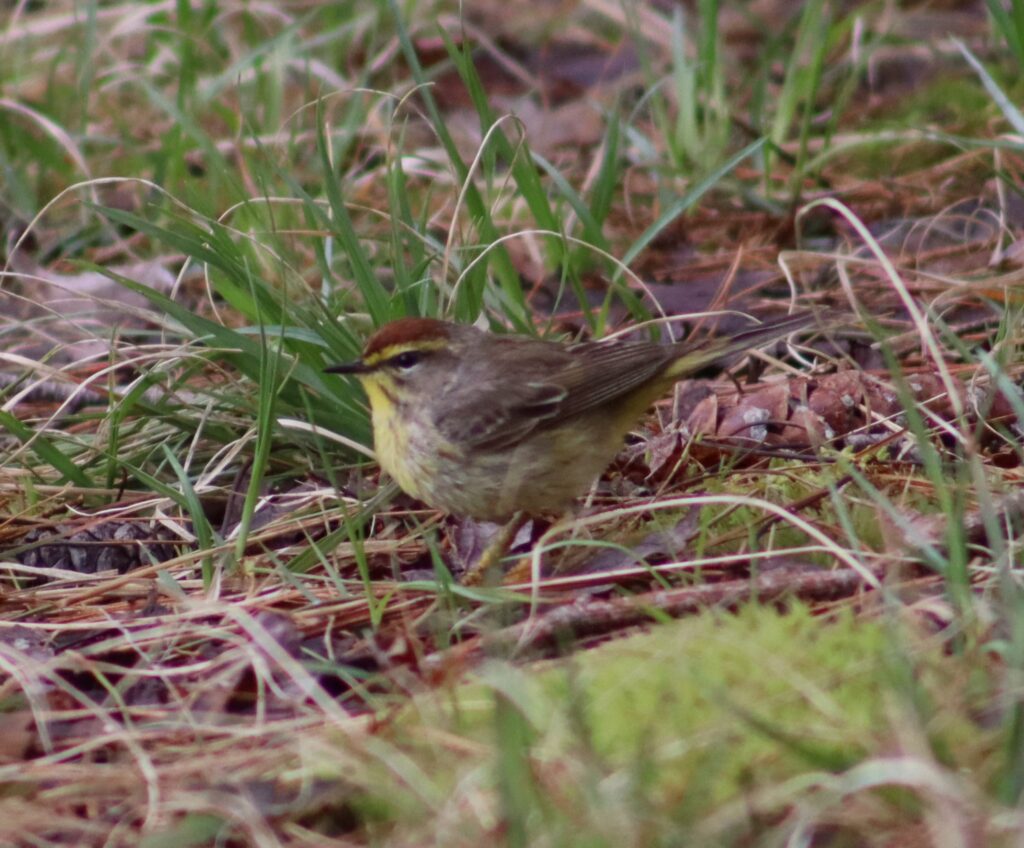
They are the most trusting of warblers. I experienced that again firsthand last weekend when my family and I took a hike around Alfred University’s Foster Lake, which is a warbler mecca during migration. Despite constant education on the matter from their naturalist father, my kids aren’t the quietest bunch in the wilds. I guess when 3 of 4 are under the age of 10 that comes with the territory. Their chatter and glee kept birds a little far from us, except for some palm warblers. One was exceptionally tame, fluttering about just feet from my oldest daughter. Then, it decided to walk near the six of us with nary a care in the world.

It’s also that behavior of walking around that makes them accessible to birders. Unlike most warblers, they are ground foragers (like their cousin, the ovenbird), staying away from the treetops and finding their food on the ground or in shorter trees and shrubs that are just a few feet tall. You might even see them flocking with other ground-dwelling birds like juncos and sparrows, feeding among the grasses at forest edges and in backyards.
Once encountered, you will find this to be a fine bird. It has a light-brown if not olive back, a yellow breast flecked with brown, and a bright, rusty cap. It’s an amalgamation of colors that seems patchwork; but, it works. What makes them unusual among the warblers is the fact that the males and females are almost indistinguishable from each other (the males of most warblers are starkly more colorful than their ladies). Palm warblers also exhibit a behavior you see out of many birds that spend their time on the ground, like sandpipers and thrushes – they bob or wag their tail.
Palm warblers are migrants, here with us only during their travels, from mid-April to mid-May (and then again from late-August to late-September). Now, they are on their way to Canada, where they raise their young upon the Canadian shield. Their summer habitat is in the open spaces of the otherwise dense and vast boreal forest. They nest and dine in the grasses and open air around bogs, swamps, and lakeshores. It breeds farther north than all other warblers except the blackpoll.
You might be wondering: If this is a bird of the far north, where did the moniker of palm come from? Well, they spend their winters in Florida, Cuba, and the Caribbean. In the late-1700s, naturalist Johann Friedrich Gmelin gave the bird its name after analyzing a specimen that was collected in Hispaniola (now known as Haiti and the Dominican Republic), where palm trees are abundant.
Get out and enjoy the warbler migration. Like our spring in general, it is a fleeting event. Luckily, our friendliest warbler gives you a chance to appreciate it up close and personal.
Exploring the Western NY Wilds is a Bob Confer project published weekly on the Sun and other WNY publications. Bob writes as a gift to our readers, generously sharing his lifetime of experience in our natural world. You can reach him anytime, Bob@ConferPlastics.com
L’Italia in Wellsville serves Lunch and Dinner Tuesday – Saturday
Take and Delivery available LItaliaOnline.com