

Part One of Three: What 911 Dispatchers Carry
A Three-Part Look at Life Behind the Headset from Casey D. Howe, veteran 911 Dispatcher and Advocate, Follow Howe’s effort on Facebook
I’ve been trying to figure out how to explain what it feels like to finish a terrible 911 call.
The caller hangs up. The ambulance is still responding. The deputy is still on the road. Firefighters may still be working. Somewhere, a family is still crying, praying or trying to understand what just happened.
And I’m still sitting in the same chair.
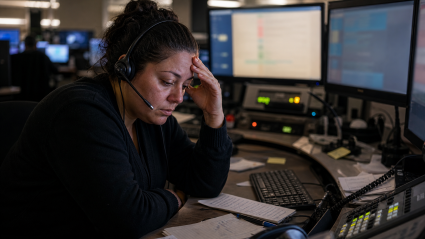
Our communications center is usually dark. Most of the light comes from the monitors in front of us. Phone screens, maps, radio channels and call information keep changing as fast as we can type. The room may look calm, but what comes through the phone is anything but.
A mother is screaming because her child isn’t breathing. A wife is begging her husband to wake up. Someone is hiding from a person who wants to hurt them. Someone else is telling me they don’t want to live anymore.
I’m trying to understand them. I’m trying to get an address. I’m giving instructions, listening to the radio and sending help while trying to keep my own voice steady.
Then the call ends.

For a few seconds, I may sit there and think about what I just heard. If I’m lucky, I may even get a chance to take a breath.
And then the phone rings again.
So I answer.
That is one of the hardest parts of this job to explain. We don’t always get time to process what just happened. There usually isn’t time to walk away, clear our heads or even find out how the call ended. Somebody else needs help, and we have to be ready for them.
I’ve worked as a 911 dispatcher and supervisor in a small rural 911 center for years. I come from a public-service family. I served as an EMT, volunteered as a firefighter and grew up around law enforcement. I knew this work would be difficult. What I did not understand was how many voices I would carry home.
A few years ago, I came in to work overtime for a coworker on Christmas Eve. I left my wife and children at home so someone else could spend that time with their family. That’s part of the job. A 911 center always has to be staffed. Emergencies do not stop because it is Christmas Eve or because your family is waiting for you.
That night, the 911 phone rang.
On the other end was a veteran suffering from PTSD. He was suicidal. He had a rifle and was threatening to end his life in front of his family. I could hear him crying. I could hear his wife crying. I could hear his 10-year-old son crying in the background.
His son was about the same age as my own boys.
For about 40 minutes, I stayed on the phone with him. I tried to keep him talking and focused on my voice. I tried to give him one more reason to stay with us, and then I tried to find another. When the troopers arrived, I had to keep him from forcing them to shoot him. I had to try to stop one tragedy from becoming several.
He survived that night. I am thankful for that. I am proud that I was able to help him through one of the darkest moments of his life.
The call ended, but the shift didn’t.
And then the phone rang again.

The next morning was Christmas. I was home with my own family, but part of me was still on that call. I kept hearing his voice and his wife crying. More than anything, I kept thinking about that little boy and what he had witnessed on Christmas Eve. I looked at my own children and wondered what that family was doing. It made for a very heavy Christmas.
That was one of the first times I admitted to myself that these calls were really starting to bother me. It wasn’t that this call was worse than every other call I had taken. It was the call that made me realize how much I was already carrying.
I think that is what cumulative trauma is. It is not always one call that breaks through. Sometimes it is hundreds or thousands of calls that you have pushed down because you had to keep working. Eventually, all of that has to go somewhere.
Dispatchers are sometimes called the first, first responders. We are there before anyone else. We may hear someone’s final breath or the exact moment a family’s life changes forever. We give CPR instructions, listen to people cry and try to bring calm into complete chaos.
We often do not get closure. Did the child live? Did the husband make it? Did the woman hiding in the bedroom get out? Did anything I said make a difference? Sometimes we never find out.
Working in a small community can make the calls even more personal. The address on the screen may be familiar. The caller may be someone you know. The police officer, firefighter or EMT you are sending into danger may be a friend, neighbor or member of your own family.
Then we carry it home.
My wife has told me that she sometimes feels like a single parent. Not just because I am physically gone at work, but because even when I am home, I am not always completely there. I may be sitting in the same room with my family while my mind is still at the console. It breaks my heart to know that she has felt that way.
This is also a culture that has not always known how to talk about pain. We show up. We deal with it. We go back to work. We can love one another and be willing to do anything for one another, yet still not know how to ask a simple question: Are you okay?
Our small 911 center has experienced the loss of one of our own to suicide. I do not mention that loss to exploit anyone’s pain. I mention it because silence is part of the problem. Mental health cannot continue to be something we discuss only after someone is gone.
I am proud of this work. Some calls end well. Few things compare with hearing the first cry of a baby you helped deliver over the phone. Those moments remind us why we keep answering.
But the good calls do not erase the hard ones. They do not erase the missed holidays, sleepless nights or the feeling that part of you is still sitting at the console long after you have gone home.
There is a real person behind the voice answering 911. That person has a family and a life outside the communications center. They get tired. They feel sadness and fear. Sometimes they are struggling while still finding a way to help a complete stranger survive the worst moment of their life.
We answer. We help. We carry it home.
And then the phone rings again.
Casey D. Howe is a supervising emergency services dispatcher in Allegany County and an advocate with NY 911 Retirement. The views expressed are his own.