
Meet and listen to the White-Spotted Pine Sawyer
Exploring the Western NY Wilds By Bob Confer
A handful of years ago, while enjoying solitude sitting outdoors, I heard a noise I hadn’t heard before. It was a subtle, paced, repetitious sound that was like clicking or grinding. I wondered if the metronomic culprit might be a cricket or tree frog.
Always wanting to get a good picture to supplement this column or one of my daily #Nature365 posts on social media I snuck up on it. Expecting to see some sort of crawling creature on a log I was startled to discover that the noise was instead coming from inside of the log – which, by the way, wasn’t hollow.
I couldn’t wrap my head around what I just experienced. What could have made that noise?

A week or two later I had my “eureka!” moment when, in that same area, I saw a white-spotted pine sawyer. It was then I realized the noise I heard was the larva of the species. The babies are what give this beetle its name as the sound of them chewing wood is reminiscent of a small saw. The fact that the larva’s jaws – and just one larva, at that — could be heard from 30 feet away impressed. It continues to do so in the years that have followed, now that I know the where, when, and what of listening.
Hear it for yourself,
Ignore the video, just listen to the audio. It’s the grinding sound of a single pine sawyer larva. In this case, this chewing sound is so loud it was picked up by the basic internal microphone of my SLR camera from 15 feet away!
It’s a lot of decibels coming from a tiny thing. If you peel back the bark you will see a white, fleshy, legless grub-like creature an inch-and-a-half to two inches in length. It will be in this stage of life for two years.
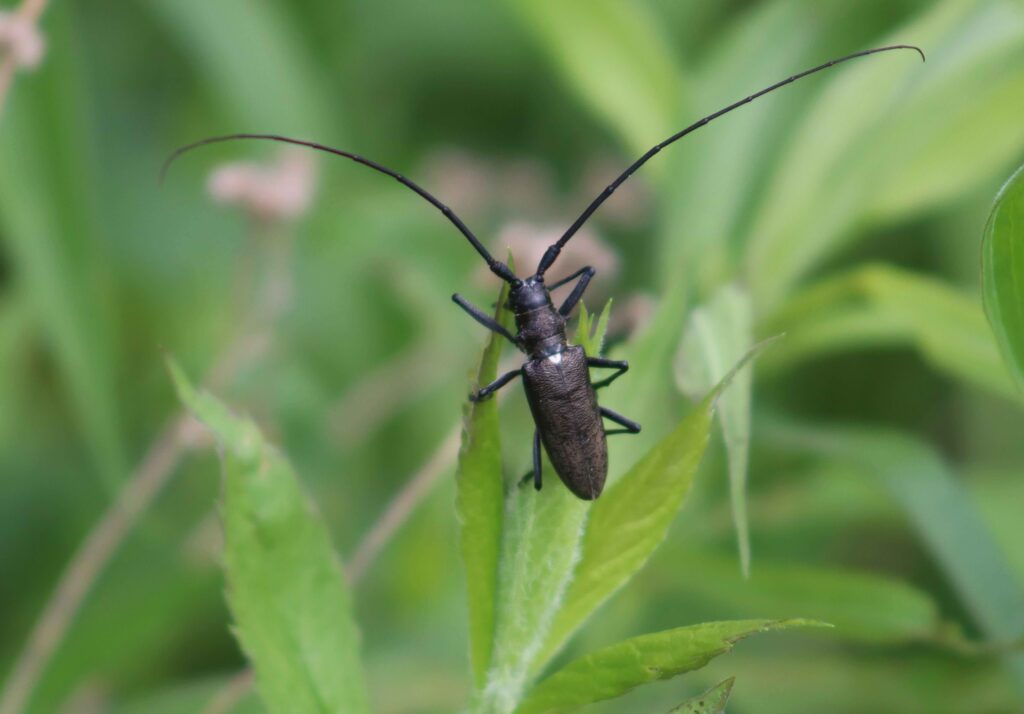
The species then spends two weeks as a pupa and after that emerges as an adult beetle, sporting a length of an inch to an inch-and-a-quarter. The black bodied beetles – with a tell-tale white spot where their wings come together — are certain to turn heads with their antennae. The males, especially, have long ones, sometimes twice the length of their body, which is why they belong to the longhorned beetle family.
Don’t be threatened by their appearance (which can easily give someone the heebie-jeebies) nor by their dining habits. The baby beetles could hardly be considered pests of pines and spruces, as they feast not on healthy, vibrant trees, but rather trees that are stressed, dying, or dead, made so by drought, disease, or other insects. This makes the larvae invaluable inhabitants of coniferous forests as they break down deadwood and are therefore part of the natural cycle of decay and decomposition.
The adults are very minor pests as they feast on the tender, new bark of young twigs, from which the trees always recover with no noticeable damage or ill effects.
This is the time of the year to see the adults crawling or flying around and to hear the young sawing away. Enjoy the wonders of what Mother Nature presents us — these baby beetles may not have sounds as beautiful as songbirds, but their noises as just as amazing — such a big noise from a little insect!
Bob Confer brings you Exploring the Western NY Wilds, regular in-depth looks at the natural world all around us. Bob has penned hundreds of columns across multiple media outlets in Western New York and can be reached anytime, Bob@ConferPlastics.com