
“The goal should never be to simply get them through the day”
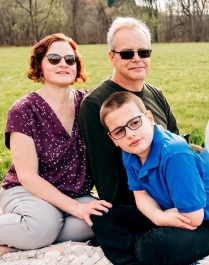
A COLUMN By Jaimie and Clayton Hulin, pictured with their son Camden
I have talked at different points before about what it means to have skin in the game when it comes to a child with a developmental disability.
For our family, that skin in the game has a name.
His name is Camden.
Camden is sixteen years old, and he is profoundly autistic. At sixteen, we are still using briefs. Communication is difficult. Some days, very difficult. But I also know enough families, and enough children, to understand that we are still lucky in many ways. I have known children with autism who do not speak at all. I have known families who would give almost anything for the level of communication Camden does have.
So I try to hold on to the silver lining where I can find it.
I tell people all the time that my son has never lied to me. There is something beautiful in that. Painful sometimes, yes. Complicated, absolutely. But beautiful too. Camden has always been Camden. No mask. No performance. No pretending to be someone he is not.
At sixteen, he is also at one of the most difficult ages in the life of a child with profound autism. His body is pulling in one direction, adolescence doing what adolescence does, while his mind and communication abilities move according to their own path. That is not a criticism of him. It is simply the reality of loving and raising a child whose needs do not fit neatly into the systems built around him.
That is why it becomes so hard to reconcile the way children with profound disabilities are sometimes treated inside rural education systems.

It is hard to accept that children like Camden may wait until the typical children are already at school before they are transported to their own educational programs. It is hard to accept that they may be brought home earlier than other children. It is hard to accept that lost time, long rides, interrupted services, and unstable placements are too often explained away with phrases like “minimum required” or “staffing shortage.”
Before we go any further, I’d like to introduce you to someone very important to me.
This is my wife, Jaimie.
She is my partner, my confidante, and one of the strongest people I know.
For years, she has worked in education. She has seen classrooms from the inside. She has celebrated small victories that most people would never notice and carried the quiet frustrations that educators often keep to themselves. She understands lesson plans, regulations, staffing shortages, and the countless demands placed upon the people entrusted with our children.
I come to this conversation as a registered nurse who has worked with people with disabilities.
She comes to it as an educator.
But neither of us comes to it first through our professions.
We come to it as Camden’s parents.
Long before the acronyms, before the meetings, before the evaluations, before the endless paperwork and phone calls, we were simply Mom and Dad trying to figure out how to help our son find his place in a world that wasn’t built with children like him in mind.
We have sat on both sides of the table. We understand that the people working directly with these children are often compassionate, dedicated, and doing the very best they can inside systems stretched beyond what they were designed to bear.
This article is not an indictment of teachers, aides, therapists, administrators, school districts, or BOCES staff.
It is an invitation to look honestly at the gap between what we promise our most vulnerable students and what many rural families actually experience.
Because when your child has profound disabilities, the stakes are different.
Education is not simply about grades or graduation.
It is about learning to communicate pain.
It is about learning to ask for help.
It is about safety.
It is about dignity.
It is about relationships.
It is about becoming the fullest version of yourself that you are capable of becoming.
And that is why this matters so deeply to us.
Not because we are looking for someone to blame.
But because we know our son.
And children like Camden deserve better than whatever happens to be left over after everyone else has been accounted for.
The treatment of students with profound disabilities in rural school systems is not equal to what is provided to general education students.
In many rural areas, districts rely heavily on third-party BOCES programs to educate students with the highest levels of need. These programs are often staffed by caring professionals doing difficult work, and many of those professionals care deeply about the children in front of them.
But good people working inside a strained system does not mean the system is working.
For some of our most vulnerable children, it is not.
We write this not only as a longtime educator and as a registered nurse who has worked with people with disabilities, but also as the parents of a profoundly autistic teenager. It is painful to watch students with significant disabilities routinely receive less consistency, fewer services, and fewer opportunities than their peers in general education.

What would never be accepted for other students has somehow become normalized for children with the greatest needs.
One of the most serious problems is the failure to consistently provide legally mandated services. Individualized Education Programs, or IEPs, are supposed to guarantee support such as speech therapy, occupational therapy, physical therapy, counseling, adaptive physical education, and other services needed for a child to access education.
Yet in many rural areas, those services depend almost entirely on whether qualified staff can be found.
When providers are unavailable, services may be interrupted for months at a time.
Our own child went more than a year without speech services because there was no one available to provide them. There have also been long interruptions in occupational therapy and other supports. Families are often told these services will later be “made up,” but that does not undo the damage caused by missing them in the first place.
What makes this even harder is that rural families often have nowhere else to turn. In larger urban areas, families may have the option of finding outside speech therapy, music therapy, physical therapy, occupational therapy, or other private services. Here, that is often not a real choice.
It took us more than a year to find a newly opened independent speech provider. Even now, that still does not meet the need of five-times-a-week speech services, but it is better than no speech at all.
And that is the kind of sentence special needs families learn to say too often.
Better than nothing.
Students with profound disabilities frequently require far more repetition, consistency, and structured support in order to develop communication, behavioral, academic, and life skills. When services disappear for months at a time, progress stalls. Some developmental windows cannot simply be reopened later with compensatory services.
Lost time matters.
Students with profound disabilities are not simply being educated for a report card, a diploma, or a test score.
They are being educated for life.
Every missed speech session is not just a missed appointment. It may be a missed opportunity for a child to learn how to ask for help, express pain, make a choice, or connect with another person.
Every missed occupational therapy session is not just a service gap. It may affect feeding, dressing, toileting, self-regulation, and independence.
Every unstable placement, every disrupted routine, every long bus ride, and every program change can echo far beyond the school year in which it happens.
For children like Camden, education is not only about academics.
It is about communication.
It is about dignity.
It is about safety.
It is about helping a person become as independent, connected, and capable as they can possibly be.
That is the long-term impact people often miss.
When services are delayed or minimized, the loss is not limited to the present moment. It can shape what kind of adult that child becomes. It can affect whether they are able to participate in their community, communicate basic needs, tolerate medical care, build relationships, develop daily living skills, or avoid unnecessary crisis later in life.
These children may always need support. We understand that. We live that truth every day.
But needing lifelong support does not mean a child should be denied the chance to grow.
It does not mean we lower expectations until all that remains is supervision.
It does not mean we warehouse children safely and call that education.
The goal should never be to simply get them through the day.
The goal should be to help them become the best version of themselves that they are capable of becoming.
You can reach Clay and his wife Jaimie anytime at, claymation_88@yahoo.com