Exploring the Western NY Wilds By Bob Confer
In the Twin Tiers (Western New York’s Southern Tier and Pennsylvania’s Northern Tier), springtime has its own flavor. Wild leeks, which are related to onions, are vernal culinary delights that many people will cook in soups with ham and/or potatoes. You’ll also find them used by small grocers and delis to lend some pungent power to sausages and dips. Some small towns will have cooking contests and community fundraisers centered around leeks.
Despite its abundance on the menu in those lands, it’s not the most abundant plant in the wild. Those who provide leeks to the grocery stores and church events on an annual basis understand that, and they know how to manage a sustainable crop that yields from the forest floor every year. But, for those who are new to the harvesting experience, it’s very easy to go overboard picking the greens and bulbs, thus wiping out entire colonies.
That’s why I often encourage people to instead pick a related plant that is quite the opposite when it comes to numbers. It’s a plant that’s so common that many people who are particular about their lawn or garden consider it to be an obnoxious pest, a weed. That plant is wild garlic.
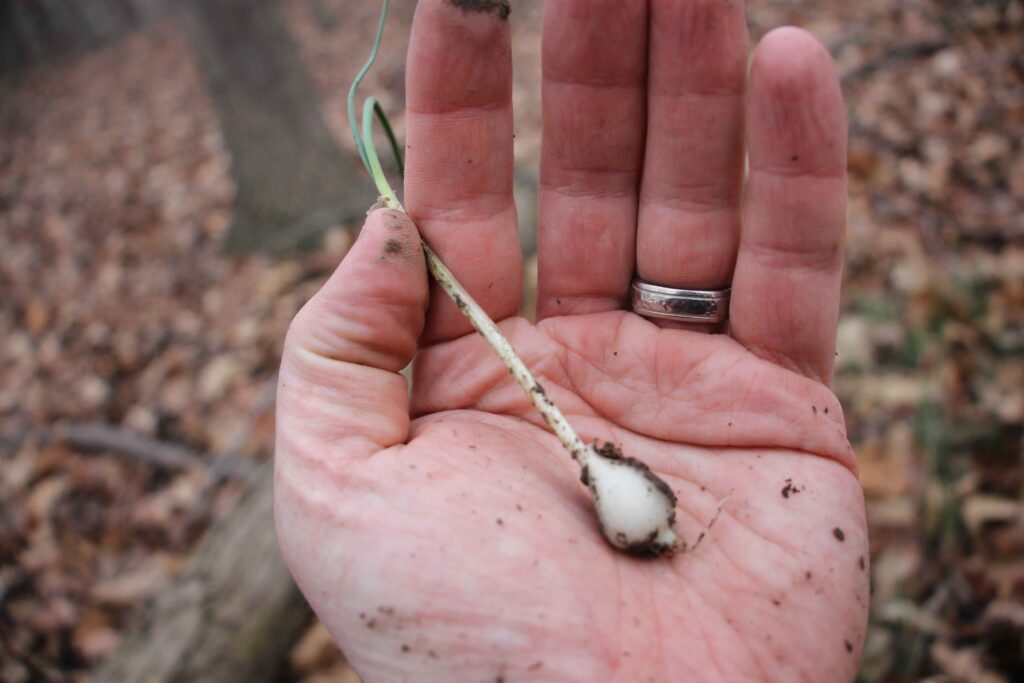
You can see it now, rising out of the ground in backyards and meadows, clusters of what look like tall spikes of dark and waxy grass. Those leaves are round and hollow, which separates them from their equally edible cousin, the wild onion.

Entire mini-economies have been built within the gardening world encouraging you to buy various herbicides to eradicate wild garlic from your lawn. Don’t spend your money on those chemicals. Not only are those leaves so waxy they inhibit the effectiveness of the spray, but chemicals, in general, alter your lawn’s biome in very negative ways. Instead, eliminate them in the most effective means possible – dig up the bulbs. When you do that, you can then eat them, too. It’s a win-win.
If you squeeze the bulbs you can smell that tell-tale scent of an onion. It’s not as powerful as a leek, but it’s strong enough to satisfy your cravings. It’s that smell, too, that can save your life. Garlic, leek, and onion bulbs can superficially look like bulbs of other plants that can harm you. A perfect example is the star of Bethlehem, a feral non-native species. That gorgeous white flower blooms in many a lawn later in the spring and it will be preceded by leaves that, when young, I could see someone easily confusing with wild onion. That flower’s very toxic bulbs aren’t stinky like the onion family’s bulbs. Remember: If it doesn’t reek, it’s not a leek (or its cousins). That potential for misidentification is why I suggest harvesting wild garlic and not wild onion — the former’s tubular leaves are less likely to be confused with other plants’ than the latter’s flat leaves.
Wild garlic bulbs can be cooked just as leeks, onions, and shallots. Chop them up, fry them, and add them to any dish imaginable…soups, stir fries, casseroles, and more. You can also fry them with a little bit of water and save that liquid as a sort of broth to touch up other foods.
Our wild leeks, onions, and garlics are very healthy, too, as they contain great amounts of vitamin A, which accounts for their traditional uses by indigenous peoples as a sort of tonic to treat colds and other ailments. They are also full of vitamin C and B1.
If you get a hankering for leeks this spring, give their cousin a try. You’ll be eliminating a weed from your lawn – an invasive species no less – and adding some kick to your menu, all while protecting the fragile population of leeks.
Exploring the Western New York Wilds is brought to you by Bob Confer, a lifelong outdoor enthusiast and citizen scientist. You can reach him anytime, Bob@ConferPlastics.com