

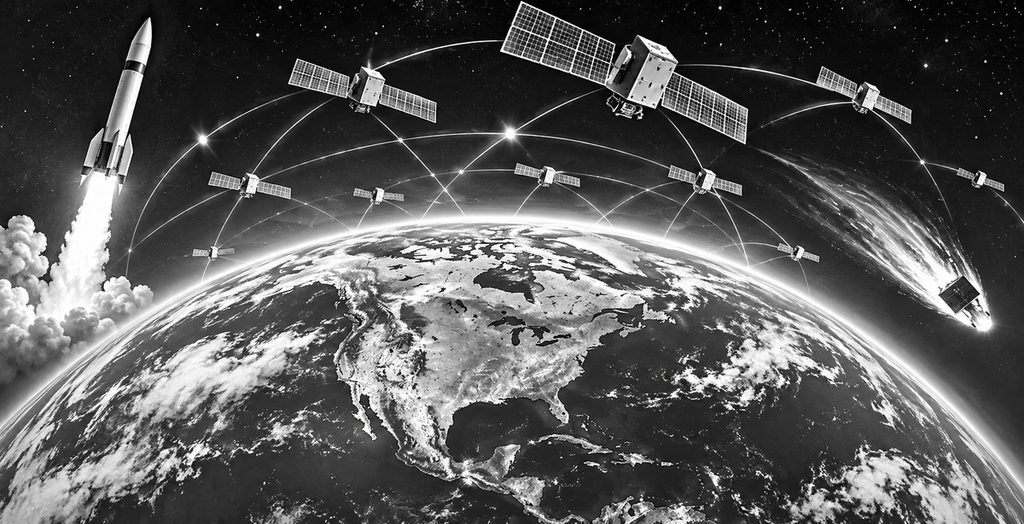
Thousands of new satellites are entering our orbit, “who is watching?”
A OPINION By Frederick Sinclair with ChatGPT,
The New Space Race: Are we moving into a new technological era faster than we are evaluating its consequences? Is the new satellite-based space race “over our heads” in more ways than location? The question is no longer whether humanity possesses the technology to transform the space surrounding our planet into a gigantic hairnet of communications antenna arrays, but whether our scientific prowess and application of civic duty will rise to the challenges of mitigating the environmental impacts inherent in such a transformation.
Several nations are establishing space-based satellite communications systems, ranging from a few satellites in geostationary orbit to vast constellations containing thousands of satellites circling the Earth. Many of these satellites have relatively short operational lifetimes and are designed to reenter and disintegrate in the atmosphere at the end of their service. U.S.-based SpaceX and its Starlink satellite system have become dominant participants in this expansion, with thousands of satellites launched since 2019 and substantial numbers already reentering Earth’s atmosphere. The Federal Communications Commission (FCC), in January 2026, authorized an additional 7,500 second-generation Starlink satellites, bringing the authorized second-generation constellation to 15,000. SpaceX has sought approval for a considerably larger constellation, but proposed satellites should not be confused with those already authorized. The environmental consequences of this rapidly expanding activity are attracting increasing scientific attention. Rocket exhaust, atmospheric emissions, and materials released when satellites burn up during reentry raise questions about cumulative impacts on Earth’s atmospheric layers. These effects require continued independent investigation, particularly as launch rates and satellite populations increase.

The benefits of global internet access for emergency situations, communications, navigation, and myriad technological applications in business, entertainment, national security, and public service cannot be ignored. But once again, the pluses and minuses need to be carefully weighed, and the merchant’s thumb kept from the scale.
A Question of Regulation — Who Is Watching? When it comes to regulating satellites and the radio frequencies they require to operate, the Federal Communications Commission licenses satellite communications systems and their use of the radio spectrum. The Federal Aviation Administration (FAA) licenses commercial rocket launches and reentries and conducts environmental reviews associated with those activities. The National Environmental Policy Act (NEPA) establishes a framework requiring federal agencies to consider the environmental consequences of major federal actions, subject to applicable exclusions and legal requirements. The Government Accountability Office (GAO) examines federal agency performance, while congressional committees also exercise oversight responsibilities.
On October 14, 2026, the FAA published a Notice of Intent to prepare a Programmatic Environmental Impact Statement (EIS) concerning SpaceX’s proposal to dramatically increase Starship-Super Heavy operations at its Starbase facility in Boca Chica, Texas. SpaceX is seeking to expand operations beyond the currently authorized maximum of 25 annual launches and 50 landings. The FAA’s new environmental review will examine a phased proposal that could ultimately reach 456 launches and 912 landings annually. These are proposed maximum operating levels under study, not operations already approved. The environmental review will examine potential impacts involving air and water quality, wildlife, coastal resources, noise, public safety, and other environmental concerns. Public participation is part of this process, with official documents and opportunities for comment available through the FAA. Despite these efforts by the FAA to apply environmental review to rocket launch operations, serious questions remain concerning the FCC’s treatment of large satellite constellations.
In November 2022, the Government Accountability Office reported that the FCC had not adequately documented its justification for applying an environmental-review exclusion to large satellite constellations. The GAO recommended that the FCC reconsider and document its approach, establish procedures for periodically reviewing its exclusions, and make public the factors used to determine when exceptional circumstances require additional environmental evaluation. As of the GAO’s 2026 status updates, these recommendations remained open. This raises a fundamental question: If thousands of satellites are launched, operated, replaced, and ultimately returned to the atmosphere, should the cumulative environmental consequences be evaluated as part of the overall system rather than considered primarily through separate regulatory decisions?
Congress is also being urged to streamline approval processes for expanding telecommunications infrastructure. Greater efficiency may be desirable, but efficiency must not come at the expense of scientific evaluation, meaningful public participation, or environmental accountability. Regulatory agencies are entrusted with protecting the public interest. That responsibility becomes especially important when technological development advances more rapidly than our understanding of its consequences.
Scientific and Civic Responsibility — The Standard We Should Demand Scientific responsibility requires independent research, reliable measurements, transparency, and cumulative impact analysis. Civic responsibility requires accountable agencies, meaningful public participation, and consideration of technological benefits alongside environmental consequences. The issue is not whether satellite technology should advance, but whether the agencies responsible for its oversight are adequately evaluating the combined effects of launch emissions, orbital operations, and atmospheric reentry.
Humanity has demonstrated an extraordinary ability to place technology above the Earth and connect people across continents and oceans. But technological achievement does not relieve us of the responsibility to understand its consequences and act accordingly. We are of this planet, and our existence depends on the life-support systems and balance in the nature thereof. As we continue to venture forth into space, we must demonstrate that we can do so responsibly, accounting for what goes up, what comes down, and how we leave what remains in between.
Fred Sinclair is an Alfred NY writer who explores technical subjects like this, extensive writing on microwave exposure, and our evolving power grid. Check out his archives here, email him anytime with questions or concerns about his OPINIONS. fpsinclair@yahoo.com
What’s going on at the Wellsville Country Club & Restaurant