
In Wellsville’s Veteran’s Memorial Park a tribute to Major Peter Keenan who perished in the Battle of Chancellorsville
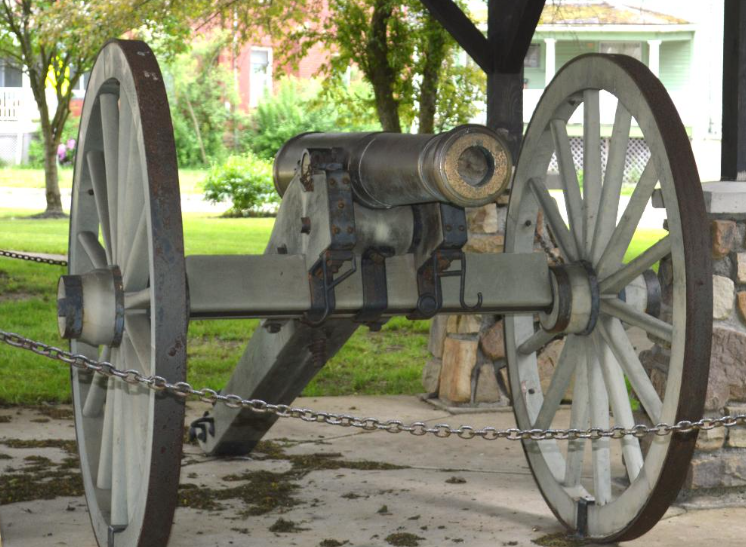
By Kathryn Ross, pictured is Veterans Park’s Civil War Cannon dedicated to Keenan
On Veterans Day many people gather under the trees in Veteran’s Memorial Park to remember and honor the village’s veterans; their friends, fathers, uncles, cousins, brothers, sons, and the women who have served this country for the last 250 years.
The park is the former site of the National Aluminum Works, a factory that burned down at the turn of the 20th Century. The triangle of land at the juncture of Brooklyn Avenue and Madison Street eventually ended up in the hands of the village. In those days, Island Park, was where the GAR Hall, along with various historical monuments, was located. The powers in charge, due to annual flooding in Island Park decided to build Veterans Memorial Park on the old factory site.
On Veteran’s Day and Memorial Day, the park, has a starring role in the village’s remembrance of its fallen soldiers. There are speeches, wreath laying and a 21-Gun Salute. However, there are two memorials among the boulders dedicated to WWI and WWII veterans that seldom receive notice – the cannon and the Keenan Memorial.
Reaching high into the sky and partially obscured by branches and in the shadow of the Civil War cannon, stands a marble obelisk dedicated to Major Peter Keenan. Today, 163 years after his last breath, we wonder who was Keenan and why is his monument in a Wellsville park?

In 1964 Charles C. Kelsey, wrote a book entitled ‘To The Knife’. It is the story of the exploits of Peter Keenan, who lived for a time in Wellsville. In the book Kelsey wrote, “It was dusk Saturday, May 2nd, 1863. General Stonewall Jackson’s Confederate forces came scrambling through the dense undergrowth pushing the panicked troops of the XI Corps back toward the small Virginia crossroad called Chancellorsville. What was to become known as Keenan’s Charge had just taken place, and young Major Peter Keenan, 8th Pennsylvania Calvary, was dead beneath the trampling feet of horses and men.”
A teacher and writer, Keenan was born in 1834 in Livingston County and moved with his family to Wellsville. On May 8, 1861, while living in Philadelphia, he became a soldier with Chorman’s Mounted Rifle Rangers. The book is available in the library at The Nathaniel Dike Museum.
The Civil War cannon displayed in Veterans Memorial Park has a past full of respect and dedication. Historically it also saw action at Chancellorsville, and at Gettysburg and Appomattox. It was assembled in 1847 at the Washington Arsenal. Its metal castings were forged at the NP Arsenal in Springfield, MA in 1846.
The cannon arrived in Wellsville in 1876, the country’s centennial. It was a gift from the government to the Dexter Post of the Grand Army of the Republic and was installed at the GAR Hall in Island Park.
A 1928 newspaper article reported, “The old Civil War cannon, which for many years adorned Island Park, is in dire straits. It has lost its luster and is on its last legs.”
A drive raised $200 to restore the cannon. By 1929 the cannon’s battered sides, crumbling wheels and its sagging framework had been repaired by the Gardner Pattern Works.
In April 1948, the village board decided to put the 100-year-old cannon into storage because of deterioration. A month later members of the Moose Lodge told the board, “The cannon is resplendent in its old-time glory and seeking a new home.”
Members of the Moose had replaced all the old wood, cleaned and polished the barrel and metal parts and repainted the relic. Moose member John Ross, a blacksmith, replaced the wood, and cut rims for the spokes by duplicating the old hand turned spokes. The rusted metal wheel bands were restored and reinforced by a local foundry. The Wellsville Burial Case Company donated a bronze plaque.
The cannon was placed in Woodlawn Cemetery. After the 1972 flood, for safety reasons, the Cannon was installed in Veterans Memorial Park beside the Keenan obelisk.
In 1987 the cannon was once again in need of repair. Village Public works employee Roy Smith restored the cannon replacing all the wooden parts of the carriage. An Amish man built new wheel hubs from blueprints supplied by the Smithsonian Institute. All repairs were made according to the original Army specs. The Civil War cannon was rededicated on Memorial Day 1989.
After listening to Wednesday’s speeches, take a look around Veteran’s Memorial Park, and remember our oldest veterans.
Kathryn Ross is a lifelong Wellsville writer, journalist, and community activist. You can reach her anytime, kathr_2002@yahoo.com
More on Major Kennan From HorseSolider.com:

“In the Catholic cemetery in Scio rests all that is mortal of one of the bravest heroes of our civil war, one whose name stands side by side with Cushing, Winthrop, Lyon and the brilliant coterie of immortals whose deeds have made them deathless. Major Peter Keenan, a resident of this county from 1851 to 1858, educated at Wellsville, and Wilson Academy, Angelica, in 1861 was a businessman in Philadelphia, and raised the 8th Penn. cavalry, the first regiment of volunteers to arrive at the scene of war. In all the bloody battles of the Army of the Potomac he bore conspicuous part and rose from captain to major by his merit and gallantry. At the battle of Chancellorsville, at the sacrifice of his own life and the lives of most of his regiment, he checked the supposed invincible legions of Stonewall Jackson and averted the stampede and destruction that threatened General Hooker’s army. At twilight of May 2, 1863, Jackson’s division of the Confederate army fell upon the 11th corps (Gen. O. O. Howard’s), the right wing of the Union army, and drove it back with such fury that cannon, caissons, cannoniers and infantry, in mingled confusion, covered a mile of the road to Chancellorsville. Gen. Hooker ordered Gen. Pleasanton to do something to stay the conquering rebels, and Major Keenan was ordered to lead his regiment to support the flying corps. With unflinching courage, he charged the Confederates and held them in check some minutes, long enough, before the regiment was annihilated, to allow the Union artillery to be placed in position and repulse the enemy. Major Keenan was shot while charging in advance of his troops. He fell upon the very bayonets of the enemy. In his death agony he tried to remount his horse but was quickly killed. His mangled body was brought from inside the enemy’s lines at night. One historian says: “In the pages of history there is not recorded a more gallant or heroic charge. It was a charge against fearful odds; a charge of 400 against 40,000; a charge of a regiment against an army; a charge made in the face of inevitable death, at the crucial moment of a great battle, to save the Union army from panic, disaster and destruction.” From the Google book entitled Allegany County and it People: A Centennial Memorial History of Allegany County, New York by John Stearns Minard, Georgia Drew Merrill, W.A. Fergusson & Company, 1896. For further reading see: To the Knife: The Biography of Major Peter Keenan, 8th Pennsylvania Cavalry. By Charles C. Keisey. And for detailed information on the regiment follow this link (8th Cavalry /89th Regiment Pennsylvania Volunteers).
