

Temperatures rising, systemic energy changes, “microgrids”
A COLUMN By Frederick Sinclair
As America is celebrating the 250 year point in the greatest system of governance ever conceived, a ‘heat dome’ and record breaking temperatures are reminding us that this grand experiment requires specific infrastructure to deliver the electricity that drives the entire mechanism. Since the first Alternating Current flowed out of Niagara Falls in 1895, an intricate delivery system has evolved which we lovingly refer to as the GRID. Population levels have soared to 350 million and infrastructure meeting the hierarchy of needs in almost every way is dependent on electricity. Let’s let that settle in for a moment. It supports heating and cooling, pumping of water, refrigeration, all devices and tools with motors, appliances, medical devices, computers, the internet, lighting, television, radio, radar, cars, communications, manufacturing etc. It is easy and right to criticize the costs of electricity going up and up, but when the GRID goes down there is only one concern, Get it back up at any cost! Recently, during heat dome temperatures over 102 F, power to an entire section of New York City was shut off from electricity in order to prevent a crash of the entire system. There was quite an uproar over the decision of who was selected to go completely without, for the ‘good of the whole’.

GRID vulnerabilities include lack of capacity in high voltage transmission lines, severe weather related demand, frequent storm damage, industrial and data center loads, and costs of generation as well as resulting pollution/waste. Terrorist and or hacking attacks, adversarial electromagnetic pulse deployment (EMP) and penetration of solar storm radiation beyond the earth’s protective magnetosphere, are very real potential GRID knockout punches. The multiple ways in which the infrastructure, that delivers such a critical resource, can be damaged and disrupted, are spurring on discussions about ‘hardening’ the GRID as well as the development of new sources, modes of generation, storage and delivery. It is important to note that for decades the US government has been in complicity with industry and investors in squashing innovation. Thousands of inventions, seeking patents, have been captured, under The Secrecy Act, and their release to production halted. The efficiency of solar panels and other energy saving devices, that were granted patents, have been restricted to levels of efficiency that will not disrupt the profits of the energy cartel and investors. Genius inventers have been murdered, their breakthroughs stolen and buried with them. The safe of Nicola Tesla was emptied by government agents immediately after his death and his solutions that could have satisfied energy needs, were locked away. Industry controllers of the GRID and related energy technologies are now conceding that something has to be done or we all will be faced with a catastrophic collapse of the GRID.
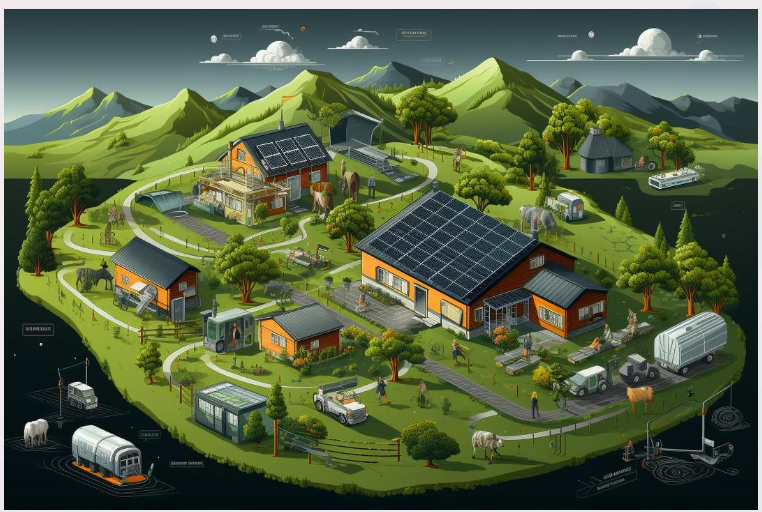
A solution, that can mitigate existing threats and seed resiliency into the fragile GRID, was proposed by the Grid Development Office of the U.S. Department of Energy (DOE) in 2024. It proposes and finances the establishment of Microgrids. Authorized by Section 40101(d) of the Bipartisan Infrastructure Law (BIL), “The Grid Resilience and Tribal Formula Grants program is designed to strengthen and modernize America’s power grid against wildfires, extreme weather and other natural disasters that are exacerbated by the climate crisis.” This concept can be applied to a standalone home or larger multiple user system that utilizes solar and or other alternatives for generation with battery storage. The larger application of Microgrids will connect a number of locations in small designated regions, which are able to function independently, but also maintain a connection to the main GRID, for selling to and or purchasing electricity. This is an elegant solution to the weaknesses plaguing the existing system. Microgrids can incorporate renewable energy, reducing greenhouse gasses and air pollution. They can also allow for decentralized demand response, localized management, security of supply, localized disaster preparedness, and price control/revenue as well as promote economic development and local jobs.
NOTE: The complete U.S. DOE of Energy report and grant information can be found at Microgrid Overview https://www.energy.gov/sites/default/files/2024-02/46060_DOE_GDO_Microgrid_Overview_Fact_Sheet_RELEASE_508.pdf
The key component of any small or large scale Microgrid is the fuel proposed for generation of combined heat and power. Next week we will look at the latest sources of power for generation; from modular nuclear, to extraction of Hydrogen and free energy as well as some of the latest developments in small and large battery storage systems.