

NY State Senator pleads: Pump the brakes. Bring it in for a complete overhaul. Stop it outright
A weekly COLUMN by NY State Senator Tom O’Mara
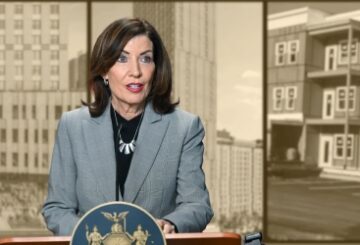
In a recent editorial, Governor Kathy Hochul wrote since “so much has radically changed since the Climate Act was enacted,” it has necessitated “common-sense adjustments that keep us on our path to a greener future in a way that is affordable for New Yorkers.”
In my opinion, not much has changed. I had predicted, before the passage of the “Climate Leadership and Community Protection Act (CLCPA)” in 2019, the huge costs now finally being realized by the governor and some Democrat majority legislators.
The governor continued in her editorial, “Absent changes to the law, the New York State Energy Research and Development Authority (NYSERDA) found the impact of meeting the Climate Act’s 2030 targets would be staggering—more than $4,000 a year for upstate oil and natural gas households, and $2,300 more for New York City natural gas households. And gas prices at the pump would jump an additional $2.23 per gallon above where it would otherwise be.”

There’s a growing recognition that “common-sense adjustments” to the CLCPA need to be prioritized and implemented. The questions remain: How hard will the governor fight for changes? How far will she be willing to go to demand necessary adjustments? How many revisions will the Democrat-led State Legislature be willing to accept?
Those are among the key issues being negotiated behind closed doors as the late state budget moves into its third week and mixed signals keep coming out of the Capitol on all of the above.
Which is why it remains important to keep highlighting exactly what needs to go back to the drawing board. On multiple fronts, it’s still sounding like New York’s all-Democrat leaders are more than happy to keep moving ahead on the CLCPA mandates, something that should be troubling to all New Yorkers.
For example, many of us have been sounding the alarm, beginning as far back as 2023, on one CLCPA mandate that we now know could be the most costly unfunded state mandate ever imposed on New York’s local school districts and school property taxpayers. Specifically, in 2022, Albany Democrats enacted a new law mandating that, starting in 2027, all school buses purchased in this state will have to be electric.
The Naples Central School District, echoing the concerns of many school districts throughout this state, recently wrote, “While we recognize the fact that we should take reasonable steps to be stewards of our environment, we cannot ignore the fact that should this mandate remain in place, the consequences could be significant for our students and community taxpayers.”
Despite constant warnings over the past few years, and despite more and more school districts and other local leaders joining the chorus of voices in opposition to the electric school bus mandate, Albany Democrats appear as poised as ever to just keep moving forward on it. In early March, two-thirds of the Senate Democrat Majority conference sent a letter to the governor stating their outright opposition to any CLCPA changes.
“We categorically oppose any effort to roll back New York’s nation-leading climate law,” they wrote.
If they win out, the fallout will be dire. That’s especially true on electric school buses.
Key reminders remain in order:
- It will be enormously expensive. Electric buses cost up to three times as much as conventional diesel buses. Additionally, schools will be required to undertake significant electrical infrastructure and distribution line upgrades, as well as address major workforce transitions. The cost of the conversion has been conservatively estimated at between $8 billion and $15.25 billion more than the cost of replacing them with new diesel buses.
- It’s simply unworkable right now. The existing electric grid can’t support it. Electric vehicles are showing an inability to operate or charge in frigid temperatures, and it does get cold in New York. Designed to operate best in 70-degree temperatures, electric vehicles lose up to 40 percent of their traveling range in extreme cold and the time required to charge them is much longer. A pilot program in Vermont found traveling range decreased by 80 percent in some instances.
- It will have yet another, enormously costly impact on the upkeep and maintenance of local roads. A diesel school bus weighs about 10 tons per axle while an electric school bus carries about 14 tons on its front axle and 25 tons on its rear axle. We have seen estimates, for example, that a town’s cost for pavement maintenance would increase from a range of $20,000 to $50,000 per mile to about $550,000 per mile for reconstruction. New York’s towns could see at least a ten-fold increase in the cost of maintaining their roads from this mandate.
If the door is indeed open, even slightly, in this year’s state budget negotiations to address changes to the CLCPA, it seems reasonable and fair to reassess and reexamine this current timeline and its potential impact on school districts, students and families, as well as local communities and economies.
If Governor Hochul, in her own words, is supportive of “common-sense adjustments,” adjusting the electric school bus mandate should be a priority.
I have already joined Assemblyman Phil Palmesano to introduce and sponsor legislation (S1908/A5168) that, among other provisions, would delay the mandate’s implementation until at least 2045 and require additional cost-benefit and safety analyses before it can take effect.
Our Western New York colleague, Senator George Borrello, has also introduced similar legislation (S4748) to rescind the mandate and direct NYSERDA to conduct a study to determine the feasibility of converting school buses to zero-emission vehicles.
The current timeline for implementing New York State’s all-electric school bus mandate raises far too many troubling questions on affordability, as well as on reliability and safety for student transportation.
Pump the brakes. Bring it in for a complete overhaul. Stop it outright. Anything would be better than allowing this electric school bus mandate to keep moving ahead as it stands.