
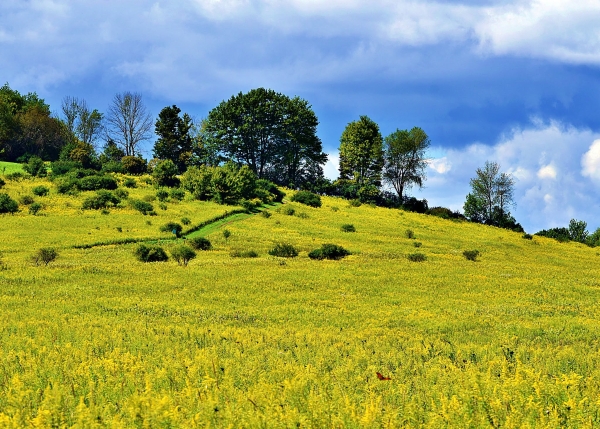

What about converting ethanol corn into solar? What about commercial rooftops ?
A OPINION from Mike Stone, Andover NY
Currently being weighed in Albany is Senate Bill S4408, which alters the existing law (ECL § 9-0507) allowing for the state to enter leases for oil and gas on reforestation lands, and increases that energy lease scope to renewable energy installations. This bill has passed the Senate, but it is not law yet. It still needs to jump the hurdles of voting in the State Assembly, and if passed, continue to Governor Hochul’s desk.
It’s not often that such a divisive topic as energy production and the environment can bring people together from opposite sides of the aisle, but this bill is being railed against by party members from both sides… and you know what? I’m in agreement. It is my firm belief that this bill is folly, but perhaps not for the reasons you might expect. I am all-in on renewable green energy and transitioning to electric resources. However, deforestation and land clearing is not the answer… mostly because it’s completely and wholly unnecessary to achieve our goals. Whatever path we choose to move forward, we must do so responsibly, otherwise we’re just kicking a different problem down the road.

There is a better solution that’s staring everyone right in the face. Here is where I make a bold claim but then provide the math (yeah, math – sorry) to support it: If we do nothing except transition ethanol corn production into solar production, we would produce roughly twice the power we currently do. That includes hydro, nuclear, coal, gas, wind… all of it, combined. Twice as much. Only for ethanol corn. Every other crop (including corn for food and animal feed), forest, etc. would be completely untouched. It’s allowing farmers to grow one type of energy instead of another and the biggest resources needed are safe and abundant.
Here comes the math. In 2025, the US produced 4,429,502 Thousand Megawatthours (or 4,429 TWh) across Petroleum, Natural Gas, Nuclear, Hydro, and Solar combined (source: US Energy Information Administration). We have approximate 31 million acres of US cropland devoted to ethanol fuel production (5.465 billion bushels, at an average yield of 177.3 bushels per acre (sources: US Department of Agriculture). Conservative estimates for the most standard type of solar field in use indicate an average power generation of 28MWh per acre per month in the corn belt (with the low end of 16.86MWh in January and the high end of 40.86MWh in June) (source, SEIA). It is often higher than that, but I figure it’s best to err on the side of caution.
That means if all we did was change ethanol corn to solar fields, we would generate ~10,356TWh of electricity on average per year. Combine that with sodium ion batteries instead of lithium (sodium is better for non-mobile grid storage anyway) to store and distribute that power along with major investment in our infrastructure all the way to the poles on our streets and we would have this problem licked with no need to ever drill, chop trees, or rely on foreign resources again. The biggest natural resources that would be used would be aluminum, silica, and sodium. All of which are in vast supply, are largely recyclable (so the 20-year lifespan of solar cells can go a long way to replenish itself, and can be easily manufactured right here in America.
Look, I’m not saying that swapping ethanol corn crops for solar farms is THE answer to our problems, I’m simply offering it as an example of what “could be” with less money and less effort than we’re already expending in crop growing and our various methods of energy production.
There are approximately 260 million acres of land in the United States that are owned by either State or Federal governments that are uninhabited, unprotected (GAP 4 status), non-DoD, (source: USGS, Census) and of that, approximately 100-120 million acres that are located on arid flatland perfectly suitable for solar fields. If 31 million acres in snow-prone corn country can yield twice the power we currently produce, imagine what just 50 million of unused, uninhabited, sunny-year-round land could provide.
Additionally, there are huge collective swaths of commercial buildings (Walmart, Home Depot, etc) with flat roofs already tied into our grid that could leverage their square footage for solar. Parking lots could erect solar shade for cars. Rebates for homeowners could also be bolstered for families that want to lessen their utility bills and even pay back excess usage into the grid. Solar fields on farms could be raised in height to allow for grazing pastures through the practice of agrivoltaics.
My point is there are a bounty of options in front of us. Some of this is already being done, but it’s too little and too slowly to effect meaningful change. New York’s plan of potential deforestation seems like a massive step in the wrong direction.
I strongly believe that our energy infrastructure needs some massive investment on a national level. Massive like “The Federal Highways Act of 1944” big. Our grid is weakening and our supply is barely keeping up with the increased demand. I also believe that increasing production of fossil fuels is the wrong way to go. Perhaps in the short term while cleaner long-term solutions are being built, but gas and oil are not long term solutions themselves.
The fact that oil, natural gas, and coal are finite resources that are a one-and-done “burn it and lose it” resource alone is enough of a reason for me to want to put it in the past. Environmental impacts, global resource conflicts, and foreign interests in domestic supply notwithstanding, if we don’t suffer the impacts of going all-in on finite resources only to watch them dry up, then we leave that burden to our grandchildren.
Working for the sake of our kids is not wasted effort, it is essential for civic responsibility. I was raised to plant trees which I will never have the pleasure of enjoying their shade. I think there’s a better solution for Albany than cutting them down.