

Red-Pill culture: How Toxic Ideologies Shape Young Minds
By: Johanna Elattar
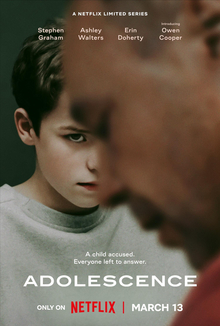
The UK mini-series Adolescence has become a global sensation, captivating audiences across 71 countries. Filmed in a continuous take, with breathtaking drone footage enhancing its immersive feel, the series follows 13-year-old Jamie Miller, whose violent outburst leads him to fatally stab his classmate, Katie Leonard, after she rejects him. The real-time car ride scenes heighten the tension, as Jamie’s emotions spiral out of control, making the narrative chillingly intense.
But Adolescence is not about courtroom drama. It is about the aftermath of violence—specifically, the destruction of relationships and the psychological devastation that follows in its wake. We’re thrust into the emotional toll Jamie’s actions take on his family, his friends, and his community, forcing us to confront a deeper question: How does a child come to this point?
The series opens with a shocking scene: police officers breaking down Jamie’s family door at 6 a.m. Our initial shock comes not from the crime but from the staggering realization that they’re arresting a 13-year-old boy. In the sterile, fluorescent-lit interrogation room, the question isn’t the usual “whodunit?” but something far more sinister: “Why done it?”

Jamie’s cold response reveals an unsettling truth: he doesn’t believe he did anything wrong. His chilling denial, after taking the life of a peer, speaks volumes about the deep-rooted entitlement, anger, and emotional disconnect that fueled his violence. In a disturbing interview with a psychologist, we are forced to face the full scope of Jamie’s rage—a psychological unraveling that serves as a warning sign of a greater societal illness.
One of the most alarming themes in Adolescence is the toxic ideologies that poisoned Jamie’s worldview. His violent actions were not born out of a vacuum but rather cultivated in the dark corners of online radicalism. Jamie is immersed in the red pill and incel subcultures—online communities where rejection is seen not as an opportunity for growth but as a betrayal to be avenged. These ideologies are not confined to the UK; they have permeated youth culture in the United States as well, where young men are increasingly being radicalized online.
Red Pill and Incel Cultures: A Dangerous Mix
The red pill culture, which began as a philosophical movement but has morphed into an online subculture, encourages young men to reject the norms of modern society and adopt a worldview where gender inequality is seen as natural and women are primarily viewed as objects to be dominated. Adherents of red pill culture claim that modern society has brainwashed men into thinking that equality is possible, but in reality, it is only a society that gives women unfair advantages. The red pill community argues that men must “wake up” to the truth of this inequality, and they encourage men to become “alpha males” by focusing on physical appearance, social status, and dominance over women.
In the U.S., red pill ideologies are flourishing among American youth, especially those who feel alienated, disenfranchised, or rejected by society. A key belief is that men’s value is determined by how dominant they are in relationships with women. In this warped version of reality, rejection is not just a normal part of dating—it’s a personal offense that must be avenged. The red pill community perpetuates the idea that women are shallow, manipulative, and only attracted to a small percentage of men who meet their high standards, creating an environment that fosters both anger and misogyny.

This toxic masculinity is often blended with incel culture, where the “involuntary celibates” believe that they are entitled to affection from women but are denied it. Central to incel ideology is the belief in the 80/20 rule—the idea that 80% of women are attracted to only 20% of men, those who are considered “alpha males” based on looks, wealth, and social status. The remaining 80% of men, who are viewed as average or undesirable, are ignored or rejected by women, leaving them feeling abandoned, angry, and vengeful.
This idea of women as entitled to “top men” has deeply damaging effects. As one expert warns, “These ideologies don’t just poison minds—they cultivate a sense of rage and entitlement, teaching young men to see women as objects to be conquered, not people to be respected.” For many young men in America, the combination of the red pill philosophy and incel resentment creates a powder keg of frustration, often manifesting in violent acts toward women or those perceived as more fortunate.
Both communities share a deeply ingrained misogyny. Women are viewed as manipulative, deceptive, and ultimately responsible for the struggles that many men face in their social and romantic lives. In these subcultures, men are taught to distance themselves emotionally from women, seeing them not as equals but as objects to be conquered, dominated, or punished. This view not only damages relationships but also contributes to a dangerous normalization of violence against women.
While Jamie’s crime is shocking, what’s more disturbing is the reaction—or lack thereof—from his peers. At Jamie’s school, his classmates seem unaffected, making crude jokes and dismissing the tragedy as just another incident. As one student remarks, “It’s crazy, but, like, it’s not even that surprising. People get hurt all the time.” Only Katie’s best friend, heartbroken and devastated, grasps the gravity of the loss, highlighting the profound disconnection between the students and the severity of the crime. This indifference speaks to a larger issue—how the normalization of violence and the desensitization to tragedy in modern society can erode empathy and human connection.
Perhaps the most gut-wrenching part of the story is the impact on Jamie’s family. His mother and sister are loving and supportive, not from a broken home or abusive background, but from a family genuinely trying to understand and help him. This is a crucial point: Not all children who commit violent crimes come from broken homes. Some are victims of something far more insidious—online radicalization and toxic, distorted views of masculinity. Jamie’s crime is a direct result of his immersion in these harmful communities, which warp his perception of human relationships and entitlement.
Adolescence is not just a story about a single, tragic event—it is a mirror reflecting the growing dangers of online radicalization, toxic masculinity, and the toxic ideologies that shape young minds. As Jamie spirals further into his psychological unraveling, the consequences for Katie’s family and friends become all too clear. We are forced to confront the uncomfortable truth: these ideologies do not just exist in isolation—they thrive and multiply in the online spaces where so many of our young people spend their time.
In the wake of such tragedies, we must ask ourselves: What are we doing to protect our children from the dangers lurking online? As society becomes more digitized, the need for comprehensive emotional support and education on navigating rejection and frustration becomes ever more urgent. We must teach our children how to reject toxic influences and become emotionally intelligent, empathetic adults, before more lives are destroyed.