Read the five common-sense ideas to lower the cost of living for New Yorkers
A weekly COLUMN by NY State Senator Tom O’Mara,
To say the least, the 2026 legislative session has kicked into high gear in Albany, and it was a telling snapshot last week of just how pivotal this year is for all New Yorkers.
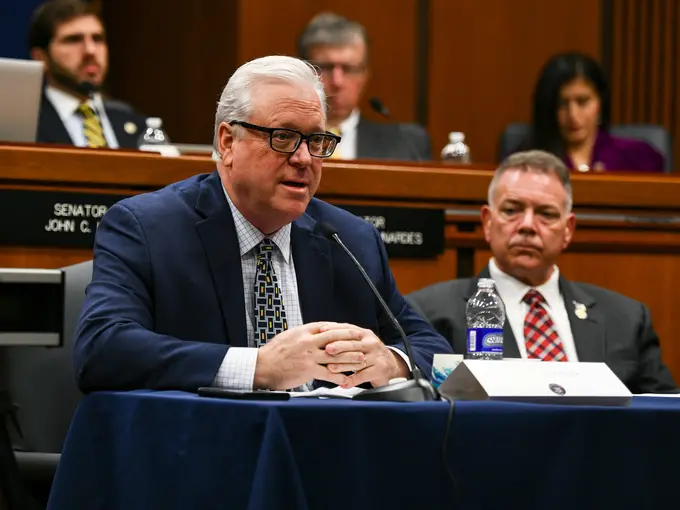
For starters, the Senate and Assembly fiscal committees began a monthlong series of legislative hearings on Governor Hochul’s proposed 2026-27 budget. Last week’s hearings focused on agriculture, energy and the environment, and education – policy areas that inevitably encompass some of the most hot-button challenges facing communities throughout New York, including skyrocketing utility costs and ominous mandates like the fast-approaching All-Electric School Bus requirement.
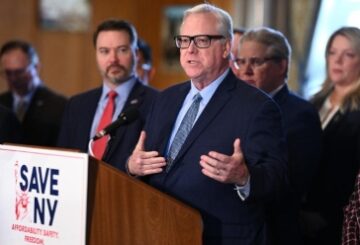
In the middle of it all, our Senate Republican Conference unveiled a report that zeroes in on the most hot-button challenge of all: affordability.
Our report, “An Affordable New York,” is the product of a series of roundtable discussions our conference began conducting late last year, in every region of New York State, focusing on what we believe are the fundamental underpinnings of the affordability crisis impacting New Yorkers, the ones that keep driving citizens and businesses away. These include taxes and regulations, energy and utility costs, accountability and efficiency in government, childcare, housing, insurance, transportation, and the cost of everyday necessities like food and groceries.
The report represents a central component of our conference’s overall “Save New York” legislative agenda for 2026 and it puts forth a comprehensive set of proposals and recommendations for legislative action, including legislation that I currently sponsor (S8461) that would return unused funds from the New York State Climate Investment Account directly to ratepayers, providing nearly one billion dollars in relief to ratepayers at a time when utility bills are skyrocketing.

‘It’s a point I raised directly at last week’s budget hearing on energy. The New York State Energy Research and Development Authority (NYSERDA) imposes a significant surcharge on every ratepayer’s utility bill that exists as a primary source of funding for Albany Democrats to carry out their Green New Deal climate agenda. According to NYSERDA’s own financial plan, that surplus currently sits at $2.4 billion and is projected to move forward as an estimated $2 billion-plus annual surplus over the next few years, at least. The point I stressed about this surplus was this one: Should ratepayers be asked to bear the burden of what’s become, at best, a questionable climate agenda?
It would seem to me that carrying in excess of $2 billion of ratepayers’ funds from year to year would be better returned to the ratepayers given the significant increases in the cost of electricity in New York, over a 50% increase from January 2020 to October 2025.
The bottom line on any surplus, in my view, is straightforward: Wouldn’t it be more important to provide some relief to ratepayers rather than to have it sitting in NYSERDA’s bank account or in a utility’s coffers?
But back to “Affordable New York,” which you can find on my Senate website, www.omara.nysenate.gov.
A few of the highlights of our legislative proposals include actions that would:
>Eliminate state personal income tax on the first $50,000 for single filers and $100,000 for married filing jointly. Lower the tax rate to 4% for single filers up to $250,000 and $500,000 for married filing jointly. This would provide a personal income tax cut for all New Yorkers, providing $30 billion in tax relief over its 10-year implementation without having to cut funding from vital state programs;
>Establish the New York State Commission on Regulatory Efficiency to examine state regulations and identify unnecessary and wasteful state regulations. New York has over 300,000 regulations, the second most of any state only behind California;
>Provide a one-year utility bill tax and surcharge holiday and a two-year green energy tax holiday. Government taxes and fees account for between 25% to 50% of a customer’s utility bill;
> Establish the First-time Homebuyer Tax Credit Act, and repeal the All-Electric Building Act, which adds approximately $20,000 to $25,000 to the construction cost of a single-family home;
> Fully fund the Child Care Assistance Program in this year’s final state budget to ensure all eligible families receive proper support with childcare expenses, and supplement New York’s existing child tax credit by providing a $1,000 “baby bonus” refundable tax credit for parents of newborns.
New Yorkers need state government to do more than just talk about how hard it is to make ends meet or how unaffordable it is to live, work, and raise a family in New York. It’s time to do something about it. It’s time to address the root causes of unaffordability in this state, especially high taxes, out-of-control spending, overzealous regulations and mandates, and energy policies that lack common sense, among others. The Albany Democrats in charge talk about New York State’s affordability crisis but their actions continue to show that they have no real interest in turning things around. Their vision for New York remains a vision built on irresponsibly spending billions upon billions of taxpayer dollars.
Senate Republicans believe “Affordable New York” deserves to be part of the discussion in state government this year and well into the future.