Grammar groaning galore, the “Warbler,” and a new poem made in Scio NY
By Chuck Wiser, I write the words to share what my eyes see and my heart feels
If you were really looking forward to, or anticipating the second chapter of my review of 2025 Wramblings, I’m afraid I’m going to have to disappoint you, at least for a while. Last week’s “Wrambling review,” considering authoring time, was by far, at least as far back as I can remember, the most time consuming. I had already begun that process for the 2nd chapter of the Wrambling Wremembrances but along the way different topics kept popping up. As a “Wreview,” the memories and documentation are already logged in, so I can wrevert to them at any time. The current topical thoughts are “in passing” and if I don’t document them now, they will be forever lost.
That paragraph “in and of itself” exposes one habit and one new-found characteristic of my Wramblings. One; my unapologetic use of quotation marks. I use the quote marks to make my writings as “conversational” as I can. The written word has the shortcoming of lacking the ability to show irony, sarcasm, or word emphasis that spoken expressions can easily communicate. Two; The frequent use of commas is a second method of converting textual writing into conversational writing. In written music scores the comma is used to designate a pause, or “lift,” or hesitation. I use it that very same way in some instances.

At one point in my Wrambling writings a reader pointed out displeasure at my “overly frequent” use of commas, and/or quote marks. I reached out to him explaining, as I do here, why I use them the way I do. I don’t recall who it was, or even if he’s still a wreader, but I haven’t heard from him since. It is my sense, that perhaps early writers, as opposed to grammaticians, invented punctuation for the purposes that I now use, or overuse them. Therein I also did something that has become a writing habit of mine, in that I make up a new word, or variation of an existing word, in my writing. That drives Autodefect crazy and uses up plenty of red highlight, error indicating ink.
OK! I am going to cease and desist the Wrambling of adding the “W” to other words that start with “R.” I have a few readers and friends who have started doing that in email or Facebook communications. Note: I also use “bold print” for outlining or emphasizing certain points like names of places, persons, or prominence.
As I dressed this morning, removing the dampened night clothes, having once again experienced “night sweats,” I marveled at the thought that, despite significant perspiration I could not detect any odor that typically emanates from perspiration. I recall having those observations quite frequently lately. Therefore, prior to this writing I did a little Google searching to see if there was such a phenomenon caused by aging.
From Artificial Intelligence (AI) comes the following: “If your sweat no longer stinks, it’s likely due to changes in your skin’s bacteria, diet, hydration, hormones, or even a genetic factor, as body odor comes from bacteria breaking down sweat, not the sweat itself; improvements in hygiene, new medications, or lifestyle shifts can alter this bacterial action, making odor less noticeable or even disappear.” From another more trusted source, giving a more “technical” explanation, I found the following answer to my query; “What causes a loss of perspiration odor as I get older?”

What are apocrine glands? Apocrine glands are structures within your skin that produce and secrete different bodily substances like thick, oily sweat and earwax. Apocrine glands are part of your body’s exocrine system, and they’re a specific type of exocrine gland. Apocrine sweat glands are located mostly in your armpits and genital area. They secrete oily sweat that doesn’t have a clear function. While not fully understood, they may play some role in sexual attraction.
Another source provided: “Yes, sweat and body odor naturally change with age, often developing a distinct, greasy, or grassy scent (2-nonenal). As the body’s natural oils break down, a process that usually starts around age 40 due to declining antioxidants and hormonal shifts, though diet, health, and hygiene also play a role.
I’m not sure those comments provide any understandable, non-scientific explanations, but I have the sense that my perspiration no longer gives me a sense of scent. And thus, the explanation of today’s Wrambling title.
As long as those explanations are noted with some technical terms, and terms somehow relate to grammar, I’m going to continue on that theme. What I always thought, or at least sensed, at the ripe old age of 12 years old, I thought that Antidisestablishmentarianism was the longest word that I can still spell and speak. Before I go on to the real longest word(s), beating out the 28 letters of the aforementioned, the following paragraphs were “penned” a few nights ago. Pardon the repeats.
Preface; While still quite young, mayhap even pre-teen, I had heard a word on a TV show of some kind. The word was so impressive, and it was so long I loved it, and was especially proud to have learned how to spell it. I actually think that this was what first piqued my interest in the love of words and our language. As much as I would have enjoyed it, I doubt my tenure as an English teacher would have been very long, as I would have the students learn word twists rather than grammar and literature. Note: I thought “mayhaps” was a word I invented but in the form of “mayhap” it is a word which means exactly what I use it for, that being maybe or possibly.

The word that first got my attention was antidisestablishmentarianism. At the time I thought, or it was believed to be, the longest common word having 28 letters. Despite certainly being one of the longest words, it is beaten out in longevity by the words that only physicians would understand. Pneumonoultramicroscopicsilicovolcanoconiosis, a lung disease, has 45 letters.
Antidisestablishmentarianism, is an actual word formerly having common use when it described being against disestablishmentarianism which had its roots as the movement to end the official state support and special status of an established church, like the Church of England back in the 19th century. Given our state of affairs, and present political logic, it might eventually work its way into being a common part of our current vocabulary.
Now, at 80 years of age, I am working on learning how to pronounce and spell the word Pneumonoultramicroscopicsilicovolcanoconiosis. The meaning part is easy. It is an invented long word said to mean “a lung disease caused by inhaling very fine ash and sand dust.” I do get the “pneumonia” link to that word. If you want more information on the word, feel free to consult you PCP (Primary Care Physician) and if you can say or spell it, ask him/her what it means. 😉
Recently there seems to be a proliferation of helicopter traffic flying over. I hear them flying over, typically multiple times during the daylight hours, and I almost think I heard one the other night. Once again invoking my “poetic license” I call those flying objects helocopeters. Any idea from readers why the recent increased activity?
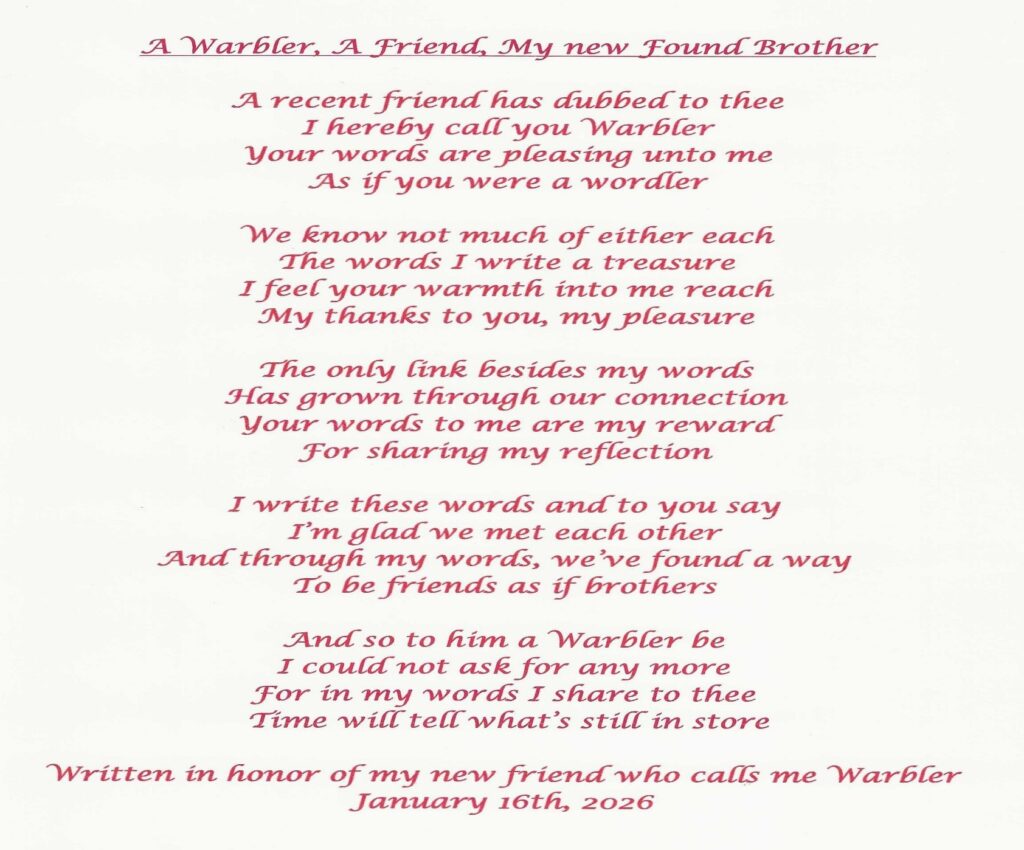
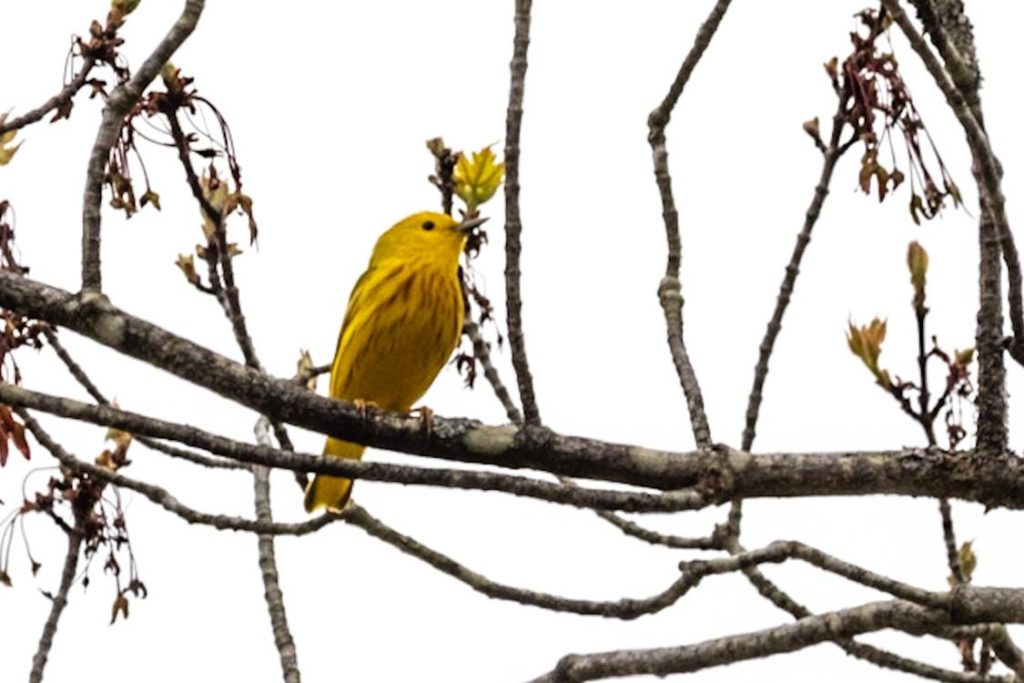
Another Grammar Groan for today is actually not a groan but an observation. The association between the word “plentiful” and the words “plenty full” is obvious. I absolutely love our language. And thus, I will share a poem generated because of recent conversations with a newly found friend who calls me the “Warbler.” I did not get his permission to use his name but may identify him later on. I will add, however, that he is older than I am so I will withhold using his name out of respect, as he is senior to me.
I absolutely look forward to hearing from readers; not out of “ego fluffing,” but I certainly look forward to hearing from them. MaryAnn is another whose comments I particularly appreciate.
If you have any comments, cares, concerns, criticisms or “cwips” please feel free to reach out to me at IM.Wiserdad@gmail.com. (PS: If you know my other email address its use is also fine). Following is a poem in honor of the friend who calls me the Warbler.