
Wolly Bears or the Farmer’s Almanac ?
A COLUMN By Kathryn Ross,
Recently I received notification that on October 15, NOAA’s National Weather Service will announce in a media teleconference, the U.S. Winter Outlook for December through February.
During the conference the director, two meteorologists and a climatologist will discuss seasonal temperature and precipitation predictions, expected changes in drought conditions and the impact of El Niño.
El Niño is a natural climate predictor. It occurs when sea surface temperatures in the central Pacific Ocean warm by at least 5 degrees, disrupting global weather patterns. It occurs every 2 to 7 years and causes wetter or drier conditions, warmer winters, and shifts in storms worldwide.
You would not think that something happening in the Pacific Ocean could impact weather conditions on the East Coast of the US, but it does.

A weather phenomenon that was recorded locally and referred to as The Year Without a Summer impacted Western New York in the beginning of the 19th Century. Newspaper articles from Buffalo to Bradford, Pa. reported snow falling in July, residents clad in winter clothing in the summer, and most importantly crop failures.
The Year Without a Summer was a climatic anomaly that occurred in 1816, when Mount Tambora in Indonesia, in the Pacific Ocean erupted in April 1815. This eruption was one of the most powerful in recorded history. Vast amounts of ash and volcanic gases were ejected into the atmosphere. For the entire year, the resulting ash cloud reduced the amount of sunlight that reached the Earth’s surface, causing a worldwide drop in temperatures.
We complain about a few days of Canadian smoke.
Indonesia is over 10,500 miles, as the seagull flies, from Western New York. So yes, El Niño impacts our weather.
Most people will tell you that meteorologists are never right. Others give them a little slack advising, “Wait five minutes and the weather will change.”
The website climatecosmos.com+1 reports, “Modern meteorologists can predict daily weather with high reliability in the short term — about 90% accuracy for 3‑day forecasts — but only around 50% for 7‑day outlooks, and beyond 10 days only broad patterns remain reliable.”
So, shall I tune into the NOAA telecast, or should I look for a more reliable method for predicting the winter ahead?
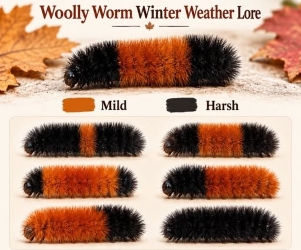
Feral Acres, is a non‑profit farm animal sanctuary in Clayton, NY. It is dedicated to rescuing and caring for farm animals. The owners recently posted a sign revealing an old Appalachian weather tradition. Their sign states, “For generations, families in Appalachia and rural communities watched woolly worms in autumn and treated their bands as signs of the winter ahead. More rust color was said to mean a milder winter. More black signals a harsher winter. The position of the dark band is thought to hint at early, middle, or late winter conditions. The head marks the beginning of winter. The center marks the middle of winter, and the tail marks the last part of winter.”
Now all you have to do is figure out which is the head and which is the tail. That takes a closer look. The head is the shiny black part and usually marks the direction the woolly bear is traveling.
According to lepidopterology, (study of caterpillars) the woolly bear caterpillar is the larval stage of the Isabella tiger moth. It is recognized by its fuzzy, banded body. They are easily identified by their dense coat of stiff bristles, or setae, which give them a woolly appearance. They measure about 1.5 inches long and feature three main color sections: black at both ends and reddish-brown or orange in the middle. They are widespread across the United States in many cold and temperate regions.
The Old Farmer’s Almanac sites other animal practices that predict winter.
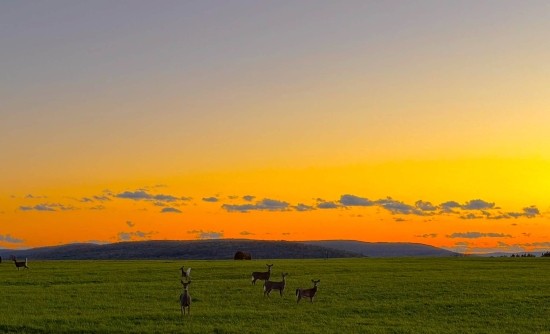
Deer
‘When deer are in gray coat in October, expect a severe winter.’ White-tailed deer transition from a reddish summer coat to a thicker gray winter coat each fall. An early gray coat means a hard winter ahead.
Squirrels
‘When a squirrel eats nuts in a tree, weather is as warm as warm can be.’ The reverse of the rule is more commonly cited: ‘squirrels burying nuts deep in fall predict a hard winter.’
I believe in the woolly bear prediction, at least I do on a crisp autumn day when I find one crawling across a concrete driveway. When an icy wind is blowing and my fingers and toes are freezing, I forget. At those times I just rage at the weatherman, because he is only correct part of the time.
Kathryn Ross is a Wellsville native and lifelong mediaite who pens the weekly Golden Girl column for the Sun. You can reach her anytime, kathr_2002@yahoo.com