

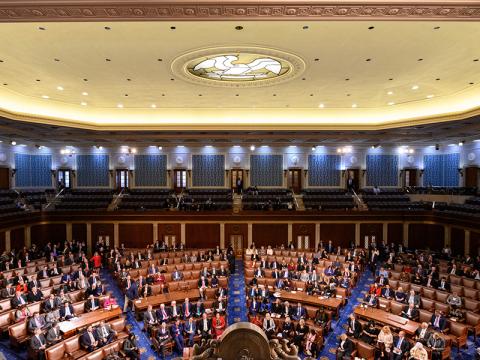
Reflections on the House of Representatives, “a bad re-creation of ancient caste systems”
A COLUMN by Steve Sprague, photo from House.gov
The U.S. House of Representatives likes to keep its indiscretions from public view. It was even worse when I first got there long ago.
This week we’ve seen two members of the House of Representatives resign over allegations and admissions of inappropriate or downright criminal relations with women who trusted them. They are, formally, referred to as “The Honorable…” Don’t we wish.
In both cases, it was no doubt the media coverage which led to these resignations. It was just a few weeks ago when House members defeated a measure that would reveal the names of members for whom settlement payments were made to satisfy sexual harassment accusations. As much as $17 million taxpayer dollars is said to have been used that way. The measure was effectively silenced when a significant majority voted to refer it to the House Ethics Committee.
While few were surprised to see the result of that vote, it caught my attention because things were much different when I went to work on Capitol Hill all the way back in 1976. Back then, the Hill was commonly called “The Last Plantation.”
It’s a little-known fact that virtually every regulation and rule contained in the laws passed by Congress can be ignored by them unless the law specifically states it applies to Congress, as well. In this case, it was 1995 when Congress was brought under the Fair Labor Standards Act of 1938. Before that, the estimated 30,000 employees of Congress had none of the rights enjoyed by most Americans at work elsewhere.

It was entirely legal back then for a member of Congress to demand that a staff member do virtually anything lest be fired on the spot with no recourse. It was common to see staff picking up the laundry, baby-sitting the member’s kids or – worse yet – being told to have intimate relations with the member or even others.
That immunity from labor standard prosecution was most distressing because of a common
practice that may still be prevalent. Almost every office hires interns and, at least back then, a young, attractive, starry-eyed receptionist to greet visitors and constituents. You can only imagine the challenges when no rules could be enforced.
While congressional staff still serve “at the will of the member,” there are now opportunities for recourse. Or at least there were before this administration eviscerated most of those offices.
Even today, it’s hard to say no to a member of Congress. The line of fawning sycophants waiting to take your job is a long one and the entire environment of the Hill is a bad re-creation of ancient caste systems. In the order of importance, Senators occupy the top seat; Senate staff is next; then elected members of the House and finally House staff. Committee staff are mere employees who do the technical stuff.
When I left the Hill in 1988, I intended to write of the perks and pleasures heaped on new members of Congress; the ones that made staying in office so important to them. I watched as well-intended freshmen were drawn into the “go along to get along” system. Values and personalities change when you’re suddenly “important” and “powerful.”
The book was never written. But I had the title ready: “Elected and Presumed Lost.”
I had been on the Hill with a new member for less than six months when the FBI entered the picture to investigate the guy who had voluntarily quit that very office just months before. That guy was this district’s rep for 8 years. Jim Hastings. By December of that year, he was convicted of taking kickbacks from employees to use for cars, snowmobiles and even his kid’s tuition. He spent 14 months in the federal prison at Allenwood, PA.
As a sidebar, back then there were no environmental controls on Congress, either. They could heat the entire Capitol complex with coal-fired generators belching black smoke over miles of the Potomac. I thought that was bad then but this administration has killed so many of today’s environmental rules now, the entire country may return to the stinky old days.
So much for “good old days” on Capitol Hill. Apparently, the Plantation really never went away. It has, however, found ways to disguise its true nature. And now many still believe they have no boundaries at all.
The new book might better be “Lost and then Elected.”
___
Steve Sprague is former Rep. Stan Lundine’s Chief of Staff, former TSA supervisor, and combat veteran writing from Steuben County NY. You can contact him anytime, SGSprague@gmail.com