
Exploring the Western NY Wilds: One of the most interesting reptiles in WNY is worth watching out for
By Bob Confer
A recent viral trend on social media has been the sharing of photographs from 2016. Users of Facebook, Instagram, TikTok and the like are reminiscing about a decade ago, showing nostalgia for their younger years, or finding escape in the perceived innocence of 2016.
Last week, I decided to participate in the craze with one of my daily #Nature365 posts, sharing a collage of nature moments from that year. One such event of 2016 really stood out, as it was my first ever – and, to this date, only – encounter with a wood turtle.
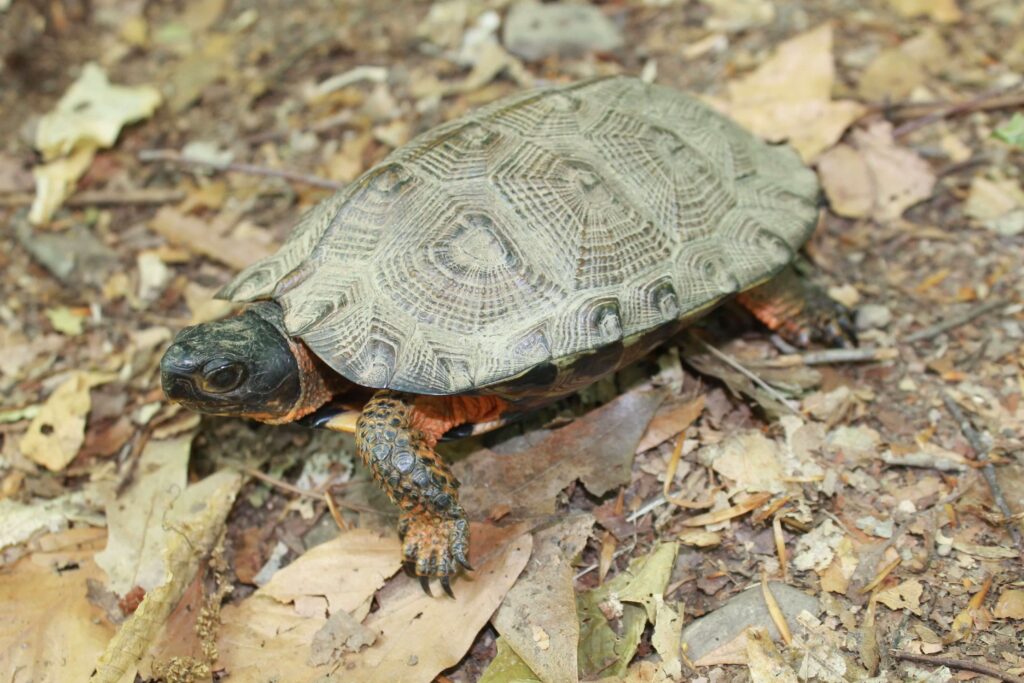
While driving on County Route 38 in Allegany County, I saw a turtle crossing the road. Like any nature lover worth his salt, I got out of the truck and picked him up to put him in a safe spot.

I expected the slow-moving pedestrian to be a painted turtle which is, without a doubt, the most common turtle in Western New York. So, I was startled – and incredibly happy — when I discovered it was a wood turtle.
It was rewarding to have my good deed magnified by protecting such a rare specimen. I count myself as a good herpetologist. During the 1990s, I explored Allegany and Niagara Counties to help the state with its amphibian and reptile atlas project. I found many interesting creatures but never expected to ever see a wood turtle. They are incredibly uncommon in Western New York and the Department of Environmental Conservation counts them as a species of special concern.
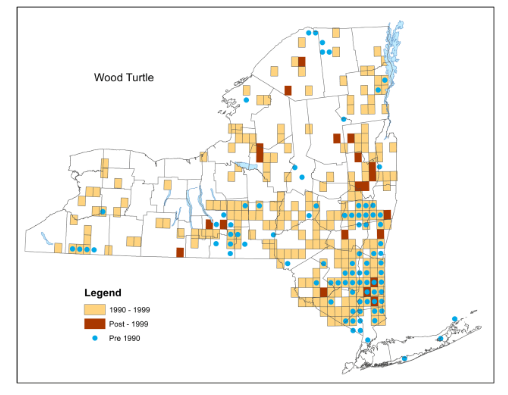
Their numbers are down in most every state and province because of predation (mostly by the overpopulated raccoons), habitat loss, illegal collection (they allegedly make great pets) and vehicular turtleslaughter.
That’s sad, because the wood turtle is one of the more interesting reptiles out there.
It got its name for two reasons: One, it’s deeply grooved shell looks like hardwood and, two, it can be found in the woods.
For a good portion of the year, the wood turtle will venture a considerable distance from water (up to a half mile). In the late-spring and summer they can be found in wet meadows, fields, and forests, foraging on insects, slugs and fungi. While hunting, it even does something one might consider a magical power: It stomps its front feet which mimics the sound of rain; those vibrations bring earthworms to the surface, making a good meal for the turtle.
They are excellent walkers and relative speedsters for the notoriously-slow turtle clan. In one study of wood turtles, it was found they averaged 354 feet of travel a day, pretty good for a small reptile no longer than 8 inches in length. When I released our road-crossing friend, my family and I were in stitches because he seemed to be in a full run and was moving rather quickly.

That ability to cover territory in a hurry aligns well with the turtle’s unique homing abilities. It was discovered in scientific experiments using mazes that wood turtles had homing abilities comparable to those of rats, which is pretty extraordinary for a reptile. A follow-up to that study had a biologist move specimens a mile and a half from home — they made it back in less than 5 weeks.
Wood turtles are attractive little souls, which might account for their popularity with reptile collectors. Besides the woody shell, they have a bright orange neck and legs and their underbelly is yellow with black blotches. They are active, too; the one we saved kept his head out most of the time, was inquisitive and even roared at us in his own way (it sounded like a whisper).
When not gallivanting in the wild during the warm months, wood turtles can be found underwater in the winter. They will go to the bottom of a river, stream or pond and bury themselves in brush or mud and stay there all season. Sometimes, that can account for their demise as it makes them susceptible to being really buried during flooding, a regular occurrence of springtime thaws in the valleys where they can be found.
That’s yet another thing makes them a marked animal – they are rare for a reason (actually, quite a few reasons), and they are creatures better left in the wild and not put in an aquarium.
If you see one in the wild appreciate it and take some pictures; never take it home.
And, if you see a turtle crossing the road, help it out — you never know just what you might be saving.
Bob Confer is the founder of Exploring the Western NY Wilds after a lifetime of exploring, learning, and researching. You can always reach him at Bob@ConferPlastics.com