Listen for: “Who cooks for you? Who cooks for you all?!”
By Bob Confer
If you are of a certain vintage you will remember how the northern spotted owl created major political and social tension in the 1990s. This rare bird of the Pacific Northwest was added to the endangered species list in 1990, which triggered numerous federal and state responses to the management of old-growth forests, their preferred habitat, none more controversial than the Clinton Administration’s Northwest Forest Plan, which pitted lumbermen against environmentalists, the welfare of workers against the welfare of birds.
Fast forward more than 30 years to today. The bird – or more specifically government’s consideration of it – is still a lightning rod for controversy. This time around, due to so much happening in the political sphere, it has attracted far less national attention, although, it should. Many people do not know that the mass annihilation of another owl – the barred owl – is underway to, allegedly, save the spotted owl.
The US Fish and Wildlife Service has a plan, either by themselves or through contracting with outside organizations and hunters, to kill 453,000 barred owls over the next 30 years in California, Oregon, and Washington. Federal wildlife officials claim that the larger and more aggressive barred owls disrupt the nesting of spotted owls, compete with them for food and, through mating and hybridization, sully the genetics of the endangered birds.
The federal government also claims that the barred owl is an invasive species, which is a stretch, because it is native to North America and a longtime resident of Canada’s western provinces from which it just happened to gradually and naturally spread its range westward and southward.
I, and numerous other nature lovers, say those forests belong to the barred owls just as much as the spotted owls…just like the forests here belong to them.

Despite being on the other side of the country, far away from this controversy, parts of New York are prime barred owl territory.
Like the spotted owl of the west, these birds love older and larger forests. Because of that, they were probably incredibly abundant in the northeast before the settlers arrived. After the mass deforestation of the 1800s, their numbers plummeted. By the 1890s, barred owls were considered rare in Western New York. But, the forests came back, and so has the owl’s population, showing a significant upward trend since the mid-1960s. It might be, now, the most common owl in the state as the previous holder to that claim, the great horned owl, is in decline.
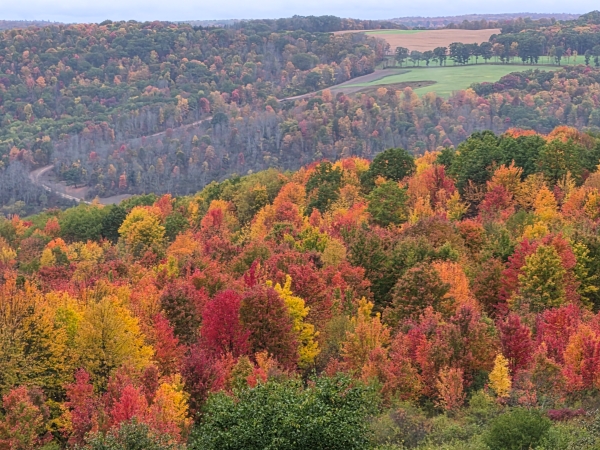
As for the readership of this column, these magnificent owls are well-established in Allegany County, where they are common in the larger private forests near the Pennsylvania border and in the state lands of the northern half of the county. In Niagara County, they are far less numerous due to the smaller size of the woods, both in acreage and tree mass. But, as the local woodlots, which just a half century ago were farmland, age further, one can expect the owl’s numbers to increase dramatically over the next 20 years. The state-owned swamplands in the southeast corner of the county afford you your best bet for seeing or hearing the owls.
And, it’s hearing them that’s so special. Their primary territorial call has been described as “who cooks for you? Who cooks for you all?!”, a tune you consider to be typical to owls. You can easily duplicate that call and get the owls to respond and even come to you. I’ll never forget such an experience that happened to me one morning 30 years ago, when, just before sunrise, I called one in and it wanted argue aggressively, from less 10 feet away. Some turkey hunters even mimic barred owl hoots to initiate “shock gobbles” out of toms, so they can determine the whereabouts of turkeys on the roost.
The owl’s other noises are also very exciting and, shall we say, unique. They make a variety of very loud, hair-raising utterances that sound like a monkey loose in the forest or a very angry cat up in a tree. Those noises have frightened many an uninitiated soul.
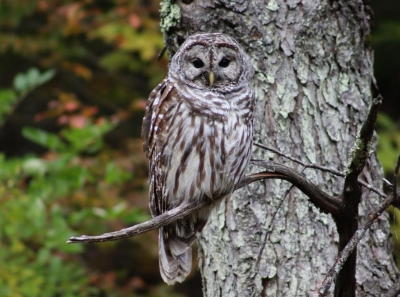
If in a big woods you encounter the owl during the day, you will find that you can get relatively close to them (if they feel threatened they fly off just a short distance). This may be for two reasons. One, they are confident in the camouflage provided by their grey/brown cross-barred feathering which blends right in with trees like cherries and birches. And, two, they may be resting – they are best adapted for nighttime flight and investigation. The black eyes tell you that – other owls, like the great horned, hunt at dawn and dusk and therefore have yellow eyes; barred owls have dark eyes to better hunt during their preferred time of total darkness.
Barred owls are a bird meant to be savored, whether heard or seen. I hope that someday soon Congress and the Senate realize that and force an end to the wrongful execution that’s taking place in the northwest. Native species shouldn’t be decimated to protect another. History, through the extirpation of wolves in the 1800s, showed us the folly in that. The past is a great teacher.
Bob Confer is the nature lover behind “Exploring the Western NY Wilds,” a regular look at just some of all that is wild and wonderful in our region. You can reach him anytime, Bob@ConferPlastics.com